
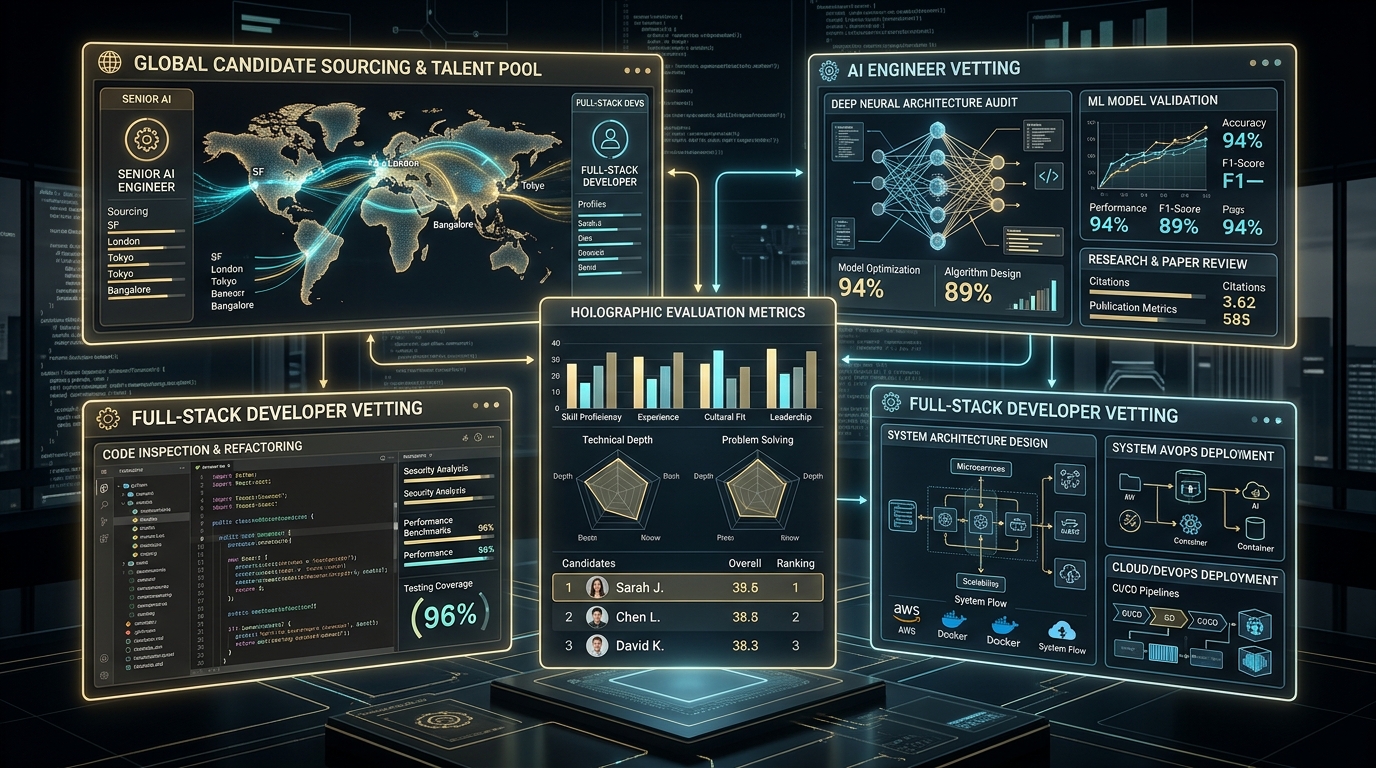
The artificial intelligence freelance market in 2026 is flooded with thousands of developers who completed a weekend tutorial, learned how to call openai.chat.completions.create(), and rebranded themselves as "Senior AI Engineers."
When founders hire on hype rather than technical verification, the result is predictable: unstable demo software that collapses under real user traffic, unbounded API bills caused by recursive agent loops, and zero deterministic data validation.
A true AI Engineer is not someone who writes clever prompts. A true AI Engineer is a senior full-stack systems architect who understands:
- How to enforce strict JSON schemas and validate outputs mathematically.
- How to build human-in-the-loop (HITL) error fallbacks when models inevitably hallucinate.
- How to architect low-latency vector databases and caching layers that prevent $10,000 monthly API surprises.
- How to integrate AI capabilities cleanly into production web stacks (Next.js 15, PostgreSQL, FastAPI, Docker).
Whether you are a US tech startup, a London boutique consultancy, or a Dubai business looking to build production AI automation, here is your definitive 2026 guide to vetting and hiring top-tier freelance AI engineering talent.
1. Prompt Wrappers vs. True AI Systems Engineers
Before scheduling interviews, review candidate portfolios and GitHub repositories against this rubric:
| Dimension | Junior / "Prompt Wrapper" Profile | Senior AI Systems Engineer Profile | | :--- | :--- | :--- | | Data Parsing | Relies on raw string regex or hopes the LLM outputs clean markdown | Uses typed Pydantic models with Instructor or native structured JSON schema enforcement | | Error Handling | Throws generic 500 errors when the LLM returns unexpected text | Implements exponential backoff, fallback model cascades, and HITL review queues | | Cost Awareness | Sends entire uncompressed documents to expensive frontier models | Preprocesses images to WebP/grayscale, uses semantic caching, and routes simple tasks to lightweight models | | Stack Breadth | Isolated Python Jupyter notebooks or Streamlit prototypes | Full-stack production capabilities: Next.js 15 App Router, TypeScript, FastAPI, PostgreSQL, Docker, AWS | | Verifiable Proof | Claims to build "revolutionary AI" with zero live links | Live deployed SaaS links, open-source repositories, published technical research, client case studies |
2. Five Technical Questions That Expose Inexperience Immediately
Use these five direct technical questions during your screening call to verify genuine production experience:
Question 1: "How do you handle model hallucinations and non-deterministic outputs in financial or legal extraction?"
- ❌ Poor Answer: "We write a very strict system prompt telling Claude not to hallucinate, or we set temperature to 0.0."
- ✅ Strong Answer: "Temperature 0 reduces variability but does not eliminate hallucinations. In production, we pass extracted outputs through deterministic Pydantic validators. For invoices, we calculate line item arithmetic ($\text{Qty} \times \text{Price} == \text{Total}$) in Python. If the mathematical audit fails or the field confidence score drops below 0.95, the system routes the record to an internal Human-in-the-Loop review queue rather than committing invalid data to the database."
Question 2: "How do you prevent agentic AI loops from running indefinitely and burning API credits?"
- ❌ Poor Answer: "The agent knows when its goal is achieved and stops."
- ✅ Strong Answer: "We enforce strict execution budgets: maximum iteration caps (e.g. 10 steps), wall-clock timeouts (e.g. 30 seconds per task), token spend limits per user session, and loop detection algorithms that abort if the agent repeats the same tool call with identical arguments."
Question 3: "When should we use fine-tuning versus RAG versus prompt engineering?"
- ❌ Poor Answer: "Fine-tuning is always the most accurate for enterprise data."
- ✅ Strong Answer: "Prompt engineering with dynamic context injection is stage 1. RAG is best when your knowledge base changes frequently and citations are mandatory. Fine-tuning should only be considered when you need to teach a model a specialized tone, unique syntax, or compact domain vocabulary where training data is abundant and RAG latency is unacceptable."
Question 4: "How do you optimize LLM API latency for customer-facing interfaces?"
- ❌ Poor Answer: "We wait for the model to finish and return the response."
- ✅ Strong Answer: "We implement Server-Sent Events (SSE) streaming for real-time token rendering, cache repeated queries with vector similarity hashing (e.g. Redis Semantic Cache), and parallelize independent tool calls using asynchronous
asyncio.gather."
Question 5: "What is your experience deploying full-stack web applications alongside AI services?"
- ❌ Poor Answer: "I only do backend Python AI code."
- ✅ Strong Answer: "I engineer end-to-end applications: Next.js 15 App Router frontend with TypeScript, Tailwind CSS, clean REST/SSE APIs, PostgreSQL with pgvector, and containerized Docker deployments on Vercel or AWS."
3. 2026 Global Freelance AI Engineer Rates
Rates vary significantly based on geographic origin, communication skills, and architectural depth:
| Region & Engagement Model | Hourly Rate Range | Monthly Full-Time Retainer | Typical Project Sprints | | :--- | :--- | :--- | :--- | | US / Canadian Senior AI Engineer | $140 – $250 / hr | $18,000 – $32,000 / mo | $15,000 – $50,000+ | | UK / Western Europe Senior Engineer | $100 – $180 / hr | $14,000 – $24,000 / mo | $12,000 – $35,000 | | Top 1% Global Remote Engineer (India / Eastern Europe) | $45 – $95 / hr | $6,000 – $12,000 / mo | $4,000 – $15,000 |
Key Insight for Founders: Hiring top-tier remote talent from hubs like India with proven US client experience gives international startups senior-grade systems engineering for 30% to 50% of domestic agency rates, without sacrificing code quality or timezone overlap.
4. How I Work With International Clients (US, UK, UAE, Canada)
When working as an independent freelance AI Engineer and Full Stack Developer, I operate under clear commercial principles:
- Asynchronous Clarity + Daily Standups: Clear Loom video walkthroughs, GitHub PR tracking, and overlapping communication windows (EST, PST, GMT, and GST friendly).
- Milestone-Based Deliverables: Every sprint has verifiable code deliverables and staging deployment links before invoice releases.
- Zero Technical Debt: Clean TypeScript, strict Pydantic schemas, modular Next.js architecture, and automated tests.
Ready to Accelerate Your AI Product?
If you need a senior engineer to architect and ship your AI SaaS MVP, automate enterprise document processing, or build intelligent conversational assistants:
- Review my verified Case Studies & Live Projects.
- Check my Freelance Services & Engagement Models.
- Explore dedicated regional portals for the United States, United Kingdom, UAE / Dubai, and Canada.
Click here to discuss your project directly with Nikhil — I review all inquiries and respond with a technical scope proposal within 24 hours.