
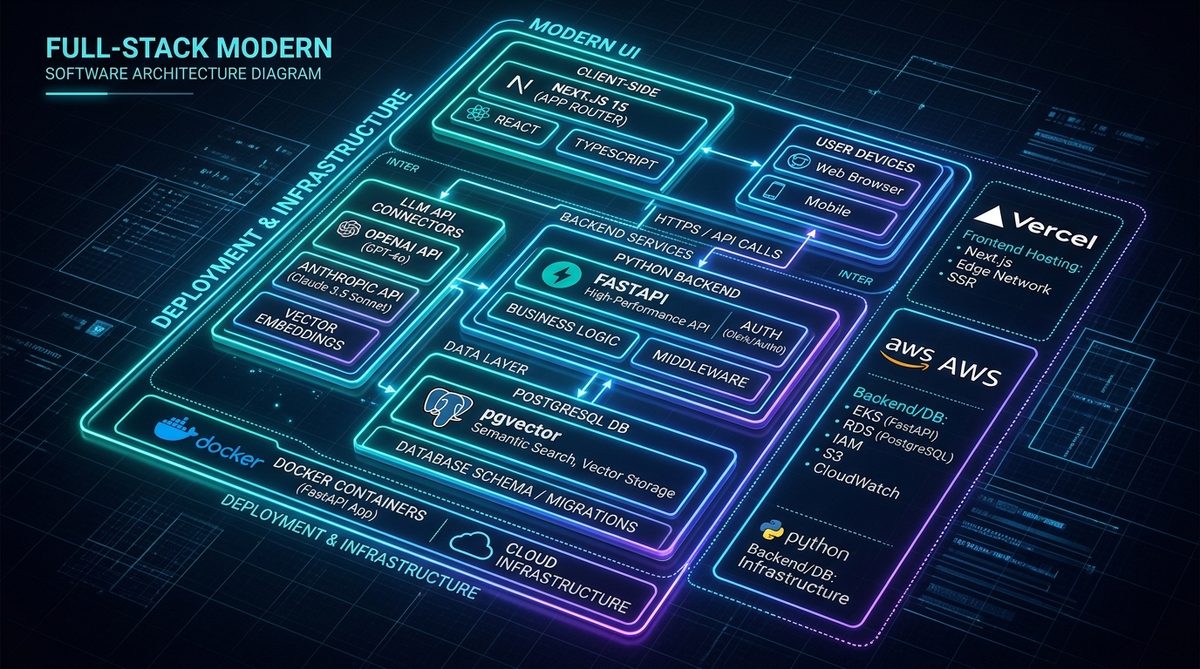
In 2026, building a production AI application requires much more than slapping an API call inside a React useEffect.
To build software that handles real users, strict enterprise data compliance, sub-second latency, and predictable cloud budgets, you need an integrated full-stack architecture. Every layer—from frontend state management to vector search indexing and backend queue orchestration—must be intentionally chosen.
As an AI Engineer and Full-Stack Developer building systems for enterprise clients at Venture7 and shipping independent SaaS products, here is the exact tech stack I use in production, along with the engineering rationale behind every choice.
1. The Core Stack at a Glance
┌────────────────────────────────────────────────────────────────────────┐
│                        CLIENT / FRONTEND LAYER                         │
│   Next.js 15 (App Router) • React 19 • TypeScript • Tailwind CSS v4    │
└───────────────────────────────────┬────────────────────────────────────┘
                                    │ HTTPS / Streaming SSE / WebSockets
                                    ▼
┌────────────────────────────────────────────────────────────────────────┐
│                        BACKEND & API SERVICES                          │
│   FastAPI (Python 3.12) • Node.js / Next.js Server Actions • REST/gRPC │
└───────────────────┬────────────────────────────────┬───────────────────┘
                    │                                │
                    ▼                                ▼
┌──────────────────────────────────────┐ ┌───────────────────────────────┐
│           DATA & STORAGE             │ │      AI & VECTOR ENGINE       │
│  PostgreSQL (Supabase / Neon)        │ │  Anthropic Claude 3.5/Sonnet 5│
│  pgvector (Semantic Search)          │ │  OpenAI GPT-4o / GPT-4o-mini  │
│  Redis (Upstash / Memory Caching)    │ │  LangGraph / Custom Pipelines │
└──────────────────────────────────────┘ └───────────────────────────────┘
                                    │
                                    ▼
┌────────────────────────────────────────────────────────────────────────┐
│                       DEPLOYMENT & INFRASTRUCTURE                      │
│     Vercel (Edge Frontend) • AWS ECS / Docker • n8n Self-Hosted        │
└────────────────────────────────────────────────────────────────────────┘
2. Layer-by-Layer Architectural Breakdown
1. Frontend: Next.js 15 (App Router), React 19 & TypeScript
For client-facing web applications and SaaS platforms, Next.js 15 with App Router is my default choice.
- Why TypeScript: When handling dynamic LLM responses, typed schemas are non-negotiable. Using Zod alongside TypeScript allows me to validate API boundaries at runtime and prevent malformed AI JSON from crashing the UI.
- React Server Components (RSC): RSCs allow direct database querying and server-side authentication checks without exposing sensitive API credentials or bloating client bundle sizes.
- Server-Sent Events (SSE) & Streaming UI: For conversational interfaces and real-time generation, streaming tokens chunk-by-chunk via Next.js Edge routes delivers instant perceived performance (Time to First Token < 300ms).
- Tailwind CSS v4 & Shadcn/UI: Provides accessible, unstyled primitives (accessible dialogs, data tables, popovers) that can be styled into sleek, dark-mode glassmorphic interfaces without the performance drag of heavy UI libraries.
2. Backend & Microservices: Python (FastAPI) + Node.js
I advocate for a hybrid backend model depending on the task:
- Node.js / Next.js Server Actions: Handlers for user authentication, Stripe subscription billing, session management, and standard CRUD data operations.
- Python (FastAPI): Dedicated microservices for heavy AI orchestration, document parsing, OCR pipelines, and vector operations.
- Why FastAPI: Native async support (
asyncio), lightning-fast Pydantic serialization, native compatibility with PyTorch/TensorFlow, and seamless integration with Anthropic and OpenAI SDKs.
- Why FastAPI: Native async support (
# Example: High-performance typed extraction endpoint with FastAPI & Pydantic
from fastapi import FastAPI, HTTPException
from pydantic import BaseModel, Field
import anthropic
import os

app = FastAPI(title="AI Document Processing Service")
client = anthropic.Anthropic(api_key=os.environ.get("ANTHROPIC_API_KEY"))

class InvoiceData(BaseModel):
    invoice_number: str = Field(description="Unique invoice identifier")
    total_amount: float = Field(description="Total invoice balance in USD")
    vendor_name: str = Field(description="Name of the billing company")
    confidence_score: float = Field(default=1.0)

@app.post("/extract-invoice", response_model=InvoiceData)
async def extract_invoice(document_b64: str):
    try:
        response = client.messages.create(
            model="claude-3-5-sonnet-20241022",
            max_tokens=1500,
            messages=[{
                "role": "user",
                "content": [
                    {"type": "document", "source": {"type": "base64", "media_type": "application/pdf", "data": document_b64}},
                    {"type": "text", "text": "Extract invoice fields strictly conforming to JSON."}
                ]
            }]
        )
        return InvoiceData.model_validate_json(response.content[0].text)
    except Exception as e:
        raise HTTPException(status_code=500, detail=str(e))
3. Database Layer: PostgreSQL + pgvector (Supabase / Neon)
In 2026, you usually do not need a standalone niche vector database (like Pinecone or Qdrant) unless you are querying billions of embeddings with high mutation frequencies.
- Why pgvector in PostgreSQL: Having relational user data (tenants, auth, billing, projects) and vector embeddings (document chunks, semantic representations) in the same database eliminates two-phase commits, simplifies database backups, and allows relational vector filtering in a single SQL query:
-- Hybrid semantic search with relational tenant isolation in PostgreSQL
SELECT
    id,
    content,
    1 - (embedding <=> $1) AS similarity_score
FROM document_chunks
WHERE tenant_id = $2
  AND is_archived = false
ORDER BY embedding <=> $1
LIMIT 5;
4. LLM Providers & Model Routing Strategy
Rather than locking into a single model, I design a model-router pattern to balance latency, accuracy, and operational cost:
| Use Case | Selected Model | Why Chosen | | :--- | :--- | :--- | | Complex Vision OCR & Structured IDP | Claude Sonnet 5 | Unrivaled spatial comprehension of complex tables, invoices, and zero hallucinated line-item math. | | Real-Time Web & WhatsApp Chatbots | GPT-4o / GPT-4o-mini | Ultra-low latency, affordable token costs, strong function calling support. | | Massive Context Analysis (Long PDFs / Videos) | Gemini 1.5 Pro / Flash | 2M token context window capable of ingesting entire legal archives without complex chunking. | | Query Classification & Semantic Routing | GPT-4o-mini / Local Llama 3 | Fast (<150ms) classification to decide which downstream pipeline to trigger. |
5. Workflow Automation & Integration: n8n (Self-Hosted)
For connecting AI pipelines to third-party business software (Salesforce, HubSpot, Google Sheets, WhatsApp Business API, Slack), I use self-hosted n8n.
- Self-hosted Docker deployment: Complete data privacy—client data never passes through third-party automation servers.
- Zero per-execution licensing: Enables high-frequency data synchronizations without compounding monthly subscription fees.
3. Production Readiness Checklist: What Makes This Stack Enterprise-Grade?
When deploying client solutions, I enforce four non-negotiable stability layers:
- Semantic Caching with Redis: Repeated identical or semantically similar queries are served directly from Redis cache in < 15ms, reducing API token costs by 30–50%.
- Idempotency Keys & Retry Exponential Backoff: Network hiccups or LLM rate limits never result in duplicate billing charges or corrupted database writes.
- Observability & Tracing: Integrating OpenTelemetry or Langfuse to monitor token usage, prompt latency, and user feedback per tenant.
- Data Isolation & Security: Zero-data retention API configurations and encrypted database volumes ensure compliance with enterprise GDPR and SOC-2 standards.
4. Why This Stack Matters for Clients
When you hire a developer to build your product, the technology stack directly impacts your business:
- Lower Monthly Running Costs: PostgreSQL with pgvector and self-hosted n8n reduces infrastructure overhead by hundreds of dollars each month.
- Fast Development Velocity: Next.js 15 and FastAPI allow rapid prototyping and fast feature iteration without sacrificing architectural durability.
- Maintainability: Clean TypeScript and typed Python schemas make it straightforward for your in-house engineering team to take over and maintain the codebase.
Build Your Next AI Application
Choosing the right technical foundation is the most critical decision in your product lifecycle.
Planning to build a full-stack AI SaaS, an enterprise automation platform, or a custom RAG solution?
Explore my full-stack web development services, check out my previous client projects, or message me on WhatsApp to discuss your application architecture.