
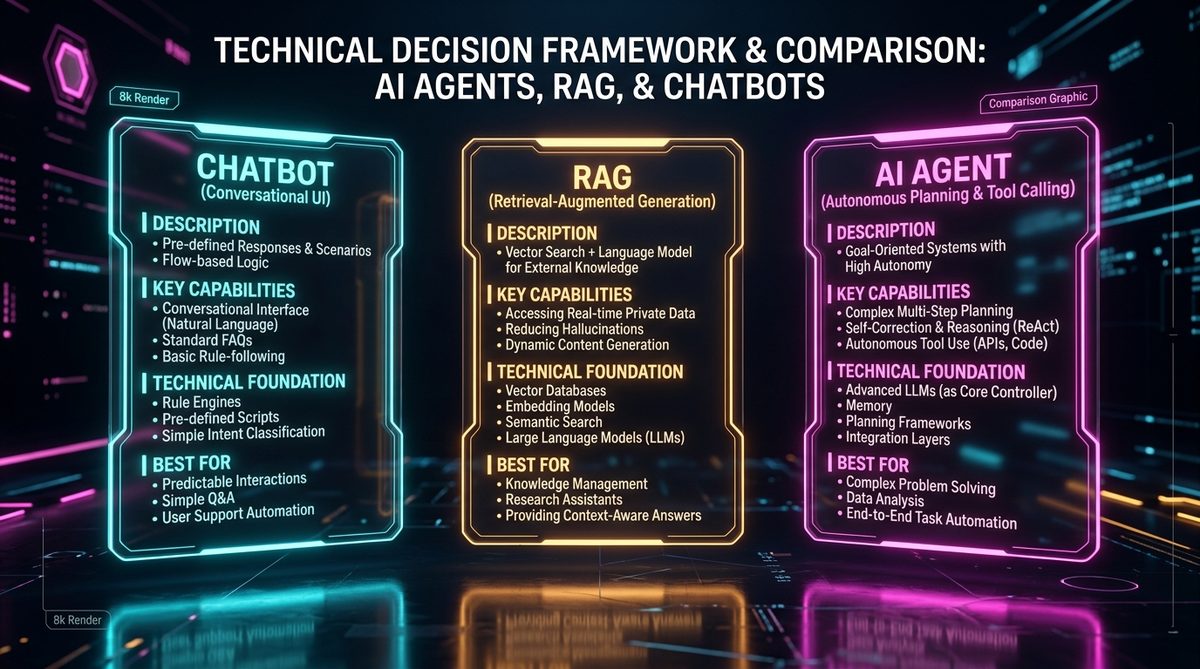
The AI industry is flooded with buzzwords: "autonomous agentic swarms," "RAG knowledge graphs," and "conversational AI assistants."
For non-technical founders, product managers, and enterprise decision-makers, this marketing hype creates massive confusion. Many companies spend $50,000 trying to build an autonomous multi-agent system when a simple 3-node RAG pipeline or a deterministic webhook script would have solved their problem at 1/10th of the cost and 10x the reliability.
As an AI Engineer & Full-Stack Developer, my philosophy is clear: The right AI architecture depends entirely on your business requirements—not on what technology is currently trending on Twitter or LinkedIn.
This guide provides an honest, clear technical framework to help you choose the right architectural approach for your product.
1. The Architectural Spectrum: Chatbot vs. RAG vs. Agent vs. Workflow
Low Autonomy (Deterministic)                                High Autonomy (Probabilistic)
┌──────────────────────┬──────────────────────┬──────────────────────┬──────────────────────┐
│  Standard Chatbot    │    RAG Knowledge     │ Deterministic Auto   │ Autonomous AI Agent  │
│  (Conversational)    │    (Search + Gen)    │ (n8n / API Pipeline) │ (Planning + Tools)   │
├──────────────────────┼──────────────────────┼──────────────────────┼──────────────────────┤
│ • Fixed intents      │ • Vector embeddings  │ • Fixed if/else logic│ • Dynamic planning   │
│ • Static FAQs        │ • Private document QA│ • Multi-system sync  │ • Multi-step loops   │
│ • No tool execution  │ • Zero hallucination │ • 100% predictable   │ • Self-healing/tools │
└──────────────────────┴──────────────────────┴──────────────────────┴──────────────────────┘
2. Deep Dive: The 4 Core Architectural Patterns
Pattern 1: Conversational AI Chatbots (Standard Interaction)
- What it is: A conversational interface powered by an LLM (like GPT-4o) with a custom system prompt and conversation history memory.
- When to build this:
- Front-desk website greetings and lead capture.
- Interactive onboarding assistants guiding users through a web app.
- Roleplay training simulators or creative brainstorming tools.
- Limitations: A standalone chatbot only knows what was provided in its prompt and training data. It cannot reliably search private enterprise databases or trigger real-world business actions.
Pattern 2: Retrieval-Augmented Generation (RAG)
- What it is: A system that connects an LLM to your proprietary, private knowledge base (PDFs, Notion docs, Zendesk tickets, SQL tables) via vector search and semantic chunking.
- How it works:
- User asks a question (e.g. "What is our policy on international equipment rentals?").
- System converts query into a vector embedding and retrieves top-k relevant document chunks from PostgreSQL (
pgvector) or Pinecone. - System injects those exact chunks into the LLM prompt with strict instructions: "Answer using only this context. Cite sources."
- When to build this:
- Internal employee knowledge portals.
- Customer-facing documentation search bots.
- Legal, financial, or medical document analysis where answers must be 100% fact-checked and cited.
- Estimated Cost to Build: $2,500 – $6,000.
Pattern 3: Deterministic Automation Pipelines (n8n / Webhooks / Python)
- What it is: Fixed, step-by-step programmatic workflows where business logic is 100% deterministic, with AI used only for localized data extraction or translation.
- When to build this:
- Ingesting incoming invoices, running OCR, validating totals, and updating your ERP.
- Syncing customer records between Stripe, HubSpot, and Slack.
- Sending automated WhatsApp appointment reminders based on calendar bookings.
- Why it wins: Unlike agents, deterministic pipelines never get stuck in infinite reasoning loops, never hallucinate API parameters, and cost almost nothing in token overhead.
Pattern 4: Autonomous AI Agents (LangGraph / Function Calling)
- What it is: An LLM equipped with a goal, memory, and a set of "tools" (APIs, web search, database query runners, code executors). The model dynamically decides which tool to call, inspects the result, and loops until the goal is achieved.
- When to build this:
- Competitive market research agents (scraping 10 websites, synthesizing data, writing a report).
- Multi-step software debugging assistants.
- Autonomous sales prospecting agents that research a lead, verify their tech stack, and craft hyper-personalized outreach.
- Key Challenges: Agents can be unpredictable, introduce latency (10–45s per task), and can run up high token bills if not bounded by strict execution loops and state machines (LangGraph).
3. The Business Decision Matrix: Which One Do You Need?
Use this decision table to match your problem to the correct architectural pattern:
| Your Primary Business Goal | Recommended Architecture | Best Tools / Tech Stack |
| :--- | :--- | :--- |
| "Answer customer questions accurately using our private manuals." | RAG Knowledge System | Next.js 15, PostgreSQL (pgvector), OpenAI / Claude API, LangChain / LlamaIndex |
| "Collect visitor emails and book demo calls on our landing page." | Conversational Chatbot + Cal.com API | Next.js 15, Vercel AI SDK, Tailwind CSS, Cal.com API |
| "Process 5,000 PDF invoices a month and insert them into Salesforce." | Deterministic IDP + Multimodal AI Pipeline | Python FastAPI, Claude Sonnet 5 Vision, n8n, Salesforce REST API |
| "Conduct automated web research, compare pricing across 20 suppliers, and draft purchase recommendations." | Agentic Workflow (State Machine) | LangGraph, Python, Tavily Search API, Structured Pydantic Schemas |
| "Automated 24/7 WhatsApp customer sales and order status bot." | Hybrid RAG + WhatsApp Cloud API | Meta Cloud API, Next.js Server Actions, PostgreSQL, GPT-4o-mini |
4. The Engineering Mistake: Over-Complicating With Agents
In 2026, the biggest design flaw I encounter in client audits is Agent Over-Engineering.
Founders often try to build a multi-agent system where:
- Agent A talks to Agent B...
- Agent B asks Agent C...
- Agent C runs a database query...
In production, each hop introduces latency compounding, cost multiplication, and exponential error accumulation.
My Architectural Rule: Always solve the problem with deterministic code first. If the problem requires knowledge retrieval, use RAG. Only introduce an autonomous Agent when the sequence of steps cannot be predicted in advance.
5. Architectural Comparison Summary
| Metric | Simple Chatbot | RAG System | Deterministic Pipeline | Autonomous Agent | | :--- | :--- | :--- | :--- | :--- | | Hallucination Risk | High | Near Zero (Grounded) | Zero | Moderate | | Latency | < 1s | 1 – 3s | 1 – 5s | 10 – 60s | | Running Cost | Minimal | Low | Very Low | Moderate to High | | Reliability | Moderate | Very High | 99.9% | Requires Guardrails | | Development Time | 3–7 Days | 1–3 Weeks | 1–2 Weeks | 3–6 Weeks |
Plan Your AI Architecture with Confidence
Building the wrong architecture wastes capital and delays your time to market. By selecting the simplest pattern that reliably achieves your business outcome, you maximize uptime, control costs, and delight your end users.
Unsure whether your project needs a Chatbot, RAG, or an Agentic Workflow?
I offer architectural consulting and full-stack development for startups and enterprise teams. Explore my AI automation services, view my interactive chatbots service, or message me on WhatsApp to evaluate your technical roadmap.