
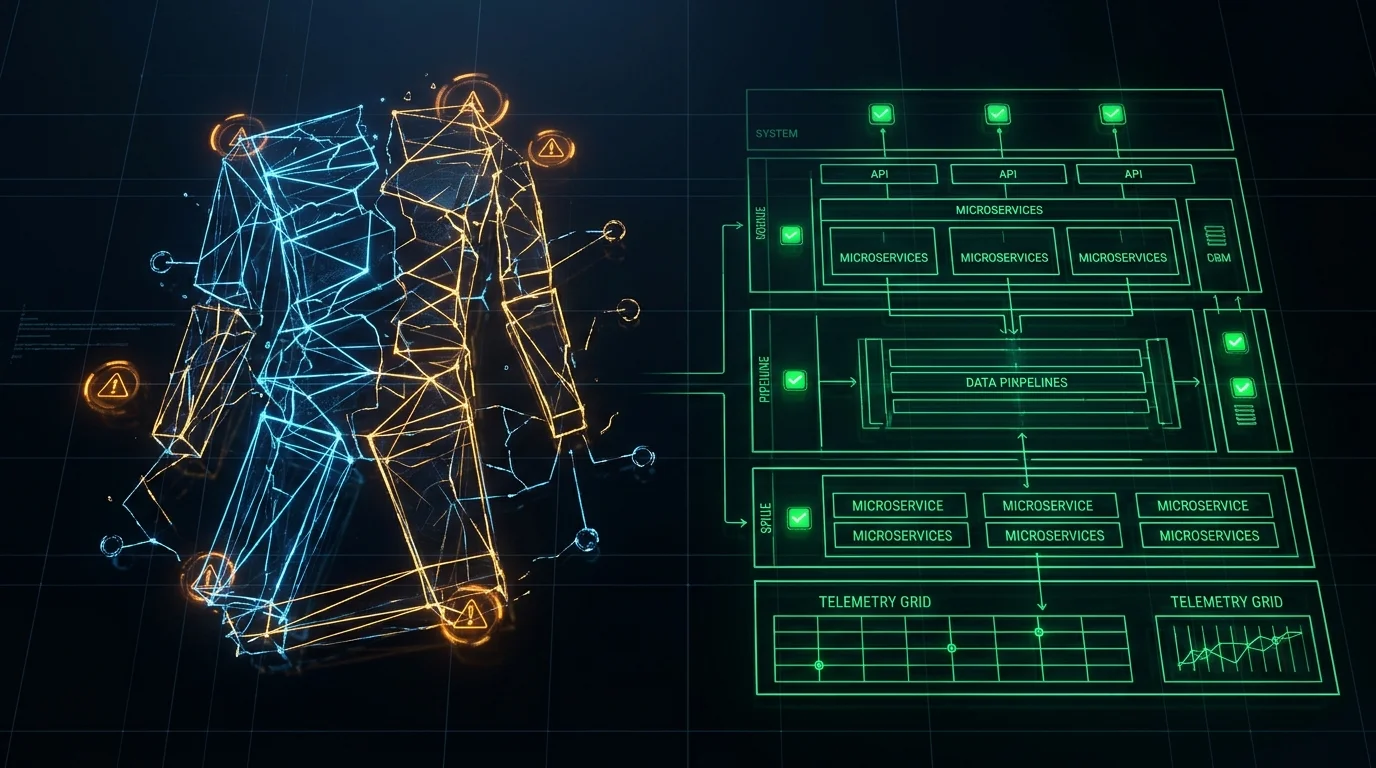
If you follow tech social media or browse developer portfolios, you would think building an AI product is essentially a resolved problem: you pull down an LLM SDK, hook up a vector database, write a three-paragraph prompt, and deploy a demo over a weekend.
Then you look at enterprise reality.
According to research across venture studios and enterprise consultancies, over 80% of Generative AI proofs-of-concept (POCs) built in 2024 and 2025 never made it to production. Of the 20% that did launch, a significant portion were quietly rolled back, throttled, or demoted to internal prototypes within 90 days.
Why is the gap between a demo that amazes an executive committee and a system that runs reliably in production so extraordinarily wide?
Having spent the past year co-building an Intelligent Document Processing platform processing ~80,000 enterprise documents monthly at Venture7 Technologies—alongside shipping high-concurrency SaaS applications and automated AI agent systems for international clients—I have watched dozens of AI projects bleed money and fail for reasons that had nothing to do with model intelligence.
The models are plenty smart. The software engineering around them is almost always broken.
Here is the honest post-mortem of why AI MVPs die in the wild, followed by the five architectural rules that separate fragile demos from production-grade enterprise software.
1. The Anatomy of an AI MVP Failure
Most failed AI projects follow an identical, depressing life cycle:
Phase 1: The "Honeymoon" Prototype (Week 1–3)
An engineer or agency spins up a Streamlit app or Next.js template. They test it against 15 handpicked sample PDFs, customer queries, or CSV files. The LLM gets 14 of them right. The founder is ecstatic, investors applaud the demo video, and the team greenlights a full rollout.
Phase 2: The First 500 Real Users (Week 4–6)
Real users do not behave like developer test fixtures. They upload skewed photographs of crumpled receipts. They ask ambiguous multi-part questions in broken English. They paste 45-page unformatted contracts into an input field designed for 500 words.
Suddenly, three catastrophic failure modes emerge:
- The Latency Cliff: Multi-agent chains and unoptimized RAG pipelines take 28 seconds to respond. Users refresh the browser, triggering duplicate API calls and burning double the tokens.
- Database Corruption: The model outputs a JSON string with an unexpected markdown code fence or a trailing comma. Downstream PostgreSQL workers crash, halting transaction queues.
- The Token Bill Shock: Because there are no caching layers, duplicate queries re-run through GPT-4o or Claude Sonnet at full price. The monthly cloud bill jumps from $200 to $7,400 with zero paying customers to show for it.
Phase 3: The Quiet Abandonment (Week 8–12)
The engineering team attempts to patch the model using longer system prompts ("Please, NEVER do X again"). The prompt grows to 4,000 words. Fixing one edge case breaks three previously working cases. Frustrated and out of budget, leadership labels the project "an exploratory R&D experiment" and shelves it.
2. The Four Root Causes Behind Every Failed AI Rollout
When you strip away the hype, every AI MVP failure can be traced to four specific software architectural blunders.
1. Treating a Probabilistic Engine as a Deterministic Database
Large Language Models are probabilistic next-token predictors. They do not "know" facts; they predict plausibility.
When developers task an LLM with things computers already do exceptionally well—such as summing numbers, filtering dates, matching exact vendor IDs, or running regex operations—they introduce non-deterministic risk into a deterministic system. If an invoice total is $1,450.20, relying on an LLM to calculate the 8.25% sales tax rather than delegating it to a native Python math function is software malpractice.
2. Zero Automated Regression Testing for Prompts
In traditional software, if an engineer alters a SQL query or a billing calculation, CI/CD pipelines run automated unit tests (pytest, jest). If a test fails, the code cannot merge.
In 90% of AI startups, someone edits the production system prompt in a dashboard on a Friday afternoon because a client complained about tone. There is no evaluation suite (evals), no test dataset of 200 historical inputs, and no metric measuring whether the prompt change caused extraction accuracy on tabular data to drop from 94% to 81%.
3. The Unchecked "Agentic Loop" Trap
Autonomous agent loops are intoxicating in demos: an agent ponders, queries a tool, reflects, re-queries, and arrives at an answer.
In production, if an agent encounters an edge case without strict recursion ceilings and execution timeouts, it can enter recursive analytical loops. Not only does this lock up user interfaces, but an autonomous agent caught in an unthrottled retry loop can consume hundreds of dollars of API credits in twenty minutes.
4. Ignoring the Domain Context Layer
Off-the-shelf foundation models are trained on the public internet. They know nothing about your company's idiosyncratic business logic:
- What does "Net 30 with 2% discount if paid within 10 days" mean for Vendor X?
- How does your company differentiate between a billing address and a remit-to address when both appear on page 1?
- What happens when an enterprise invoice references a master service agreement (MSA) signed four years ago?
Without a structured, version-controlled domain rule layer, the model is forced to guess. And when an AI guesses in enterprise accounting or legal tech, the cost of being wrong is catastrophic.
3. The Five Architectural Rules That Guarantee Production Viability
If you want your AI product to survive production traffic, handle messy data, and maintain profitability, your architecture must adhere to five non-negotiable principles.
Rule 1: The Principle of Least Intelligence
Never use a foundation model for a task that can be solved with deterministic code.
Before sending a single token to an LLM, run your data through heuristic filters:
- Need to extract an email address, phone number, or date format? Use standard regex.
- Need to verify if the line items sum to the invoice total? Run a deterministic Python validation check.
- Need to identify if a document comes from FedEx or Home Depot? Use vector embedding similarity or lightweight text signature matching.
Save the LLM exclusively for what it is uniquely brilliant at: semantic interpretation, unstructured text synthesis, and contextual understanding. This single rule typically reduces API token costs by 60% to 75% while slashing latency.
Rule 2: Hard Schema Boundaries with Pydantic / Zod
Never permit raw, unvalidated strings from an LLM to touch your database or downstream business logic.
Every model interaction must pass through strict schema enforcement (like Pydantic in Python or Zod in TypeScript). If the LLM generates a response that violates type definitions, required keys, or numerical ranges, your backend should automatically retry with a targeted corrective error message or fail gracefully to a fallback route.
Rule 3: The "Confidence Gate" (Deterministic Human-in-the-Loop)
An AI system does not need 100% accuracy to deliver massive enterprise value. It needs predictable, calibrated confidence.
In our IDP systems processing 80,000 documents per month, we do not pretend the model never makes mistakes. Instead, we compute field-level confidence scores and mathematical checksums:
- High Confidence (≥ 98.5% and math verifies): Automatically ingest directly into the ERP database.
- Low Confidence or Calculation Mismatch: Route the document immediately to a dedicated, human-in-the-loop review queue with visual bounding-box highlights.
If your system can automatically process 85% of transactions with zero human intervention and cleanly flag the remaining 15% for human review, you have eliminated 85% of manual labor without introducing a single critical error into the accounting ledger.
Rule 4: Decouple Prompts into Version-Controlled Domain Modules
Treat prompts like production source code, not arbitrary text strings:
- Keep prompts in Git repositories.
- Split monolithic system prompts into modular components: core role, domain rules, output format, and few-shot examples.
- Maintain separate, dynamic prompt files per customer or vendor layout so edge cases are isolated rather than polluting the global instructions.
Rule 5: Implement Automated Eval Harnesses Before Launch
Before you write your first marketing email or onboard your first enterprise pilot, create a frozen evaluation dataset of at least 50 real-world, messy input samples with verified ground truth outputs.
Whenever you change a model parameter, update temperature, or tweak system prompts, run your automated evaluation script. If your precision, recall, or field-level extraction rate drops by even 1%, the change does not ship to production.
4. What Founders & Hirers Should Look for in an AI Engineer
If you are a founder or engineering leader looking to hire someone to build your AI application, stop looking for people who merely brag about prompt engineering or showcase trivial chat widgets.
Look for engineers who demonstrate:
- Strong Systems Engineering Fundamentals: They care deeply about database indexing, asynchronous worker queues (Celery, Redis), schema validation, and edge caching.
- Cost & Latency Consciousness: They can tell you exactly what an average user interaction will cost in API tokens and how they plan to keep p95 latency under 2 seconds.
- Failure Mode Obsession: They ask hard questions about what happens when third-party APIs experience outages, rate limits, or non-deterministic drift.
The value of an AI engineer in 2026 is not measured by how quickly they can wire an API key to an LLM. It is measured by their ability to wrap that LLM inside an ironclad, production-grade software system that never breaks under real-world pressure.
Key Takeaway Checklist for Leadership
| Critical Question | Fragile AI Prototype | Production-Grade AI System | | :--- | :--- | :--- | | Data Validation | Raw markdown/text dumped to frontend | Strict Pydantic/Zod schema validation before database writes | | Error Handling | Application crashes on unexpected token | Automatic retry with corrective feedback + graceful fallback | | Latency Strategy | Blocking synchronous LLM calls (10s+) | Asynchronous queues, streaming UI, and edge response caching | | Cost Control | Unlimited full-context API calls per query | Semantic caching, token budgeting, and deterministic pre-filters | | Quality Assurance | Manual eyeball testing on 5 samples | Automated CI/CD eval harness against 100+ verified test cases |
Are you building an enterprise AI application, struggling with prototype reliability, or looking to transition an MVP into production? Explore my AI Engineering Services or Reach Out for an Architecture Audit.