
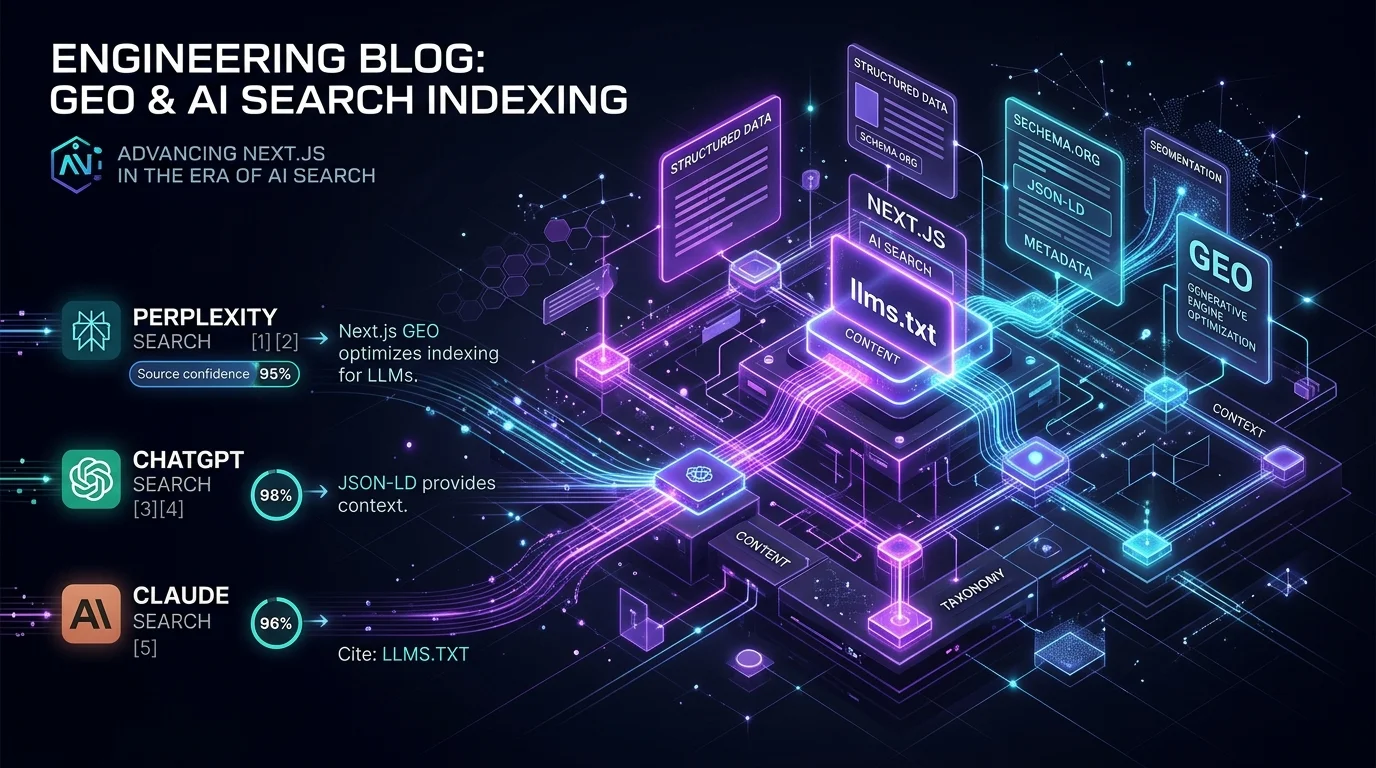
For over twenty years, search engine optimization followed a straightforward economic contract: Google ranked your web page among ten blue links, a user clicked your link, and your analytics recorded a visit.
In 2026, that contract has fundamentally transformed.
With the mainstream adoption of ChatGPT Search, Perplexity Pro, Claude Artifacts, and Google AI Overviews, millions of daily searchers no longer browse pages—they consume synthesized, multi-source answers generated directly by Large Language Models.
If your website is not structured for Generative Engine Optimization (GEO), your brand is effectively invisible in this new AI-mediated discovery layer.
Unlike traditional SEO, which optimizes for keyword frequencies and backlink pagerank to earn a click, GEO optimizes for citation probability, entity salience, and semantic extractability inside LLM reasoning pipelines.
In this technical breakdown, we explore the exact mathematical heuristics governing how models like GPT-4o, Sonnet 3.5, and Perplexity choose their sources, followed by concrete Next.js 15 implementations of llms.txt, JSON-LD entity graphs, and front-loaded answer architecture.
1. Traditional SEO vs. Generative Engine Optimization (GEO)
To optimize effectively, software engineers and growth leads must understand how the evaluation criteria diverge between traditional crawlers and generative retrieval systems:
| Dimension | Traditional Search Engine Optimization (SEO) | Generative Engine Optimization (GEO) | | :--- | :--- | :--- | | Primary Goal | Rank on page 1 of search engine results (SERP) | Win inline footnotes, citations, and model recommendations | | Target Audience | Human searchers skimming Google headlines | Multi-stage LLM agents scraping, embedding, and synthesizing | | Evaluation Mechanism | Keyword density, TF-IDF, backlink domain authority | Entity salience, semantic vector similarity, factual information gain | | Primary Metric | Organic Clicks, Organic Impressions, CTR | Citation Rate, Share of Model (SoM), Brand Prompt Frequency | | Indexing Bottleneck | Googlebot crawl budget and HTML rendering | RAG retrieval windows, context window token limits, token budget | | Content Format | Long narrative blog posts with keyword placement | Modular answer blocks, comparative markdown tables, verified statistics |
2. How Modern AI Search Engines Retrieve & Cite Content
When a user prompts ChatGPT Search or Perplexity with a complex technical query—such as "Who are the best freelance AI engineers specializing in Next.js and FastAPI?"—the underlying system does not run a simple fuzzy string match. It executes a multi-stage Retrieval-Augmented Generation (RAG) pipeline:
[ User Prompt: Complex Commercial / Technical Query ]
                           │
                           ▼
┌────────────────────────────────────────────────────────┐
│     STAGE 1: Query Expansion & Sub-Query Generation    │
│  • LLM expands prompt into 3-5 distinct search intents │
│  • Generates boolean search strings for index engines  │
└──────────────────────────┬─────────────────────────────┘
                           │
                           ▼
┌────────────────────────────────────────────────────────┐
│      STAGE 2: Multi-Source Web Retrieval & Filtering   │
│  • Fetches live pages via Bing / Google / PerplexityBot│
│  • Filters by domain trust, freshness, and robots.txt  │
└──────────────────────────┬─────────────────────────────┘
                           │
                           ▼
┌────────────────────────────────────────────────────────┐
│      STAGE 3: Text Chunking & Semantic Re-Ranking      │
│  • Chunks HTML/Markdown into 256-512 token fragments   │
│  • Re-ranks via cross-encoders (Cohere / BGE-Reranker) │
│  • Eliminates fluff, corporate jargon, and boilerplate │
└──────────────────────────┬─────────────────────────────┘
                           │
                           ▼
┌────────────────────────────────────────────────────────┐
│      STAGE 4: Context Injection & Citation Synthesis   │
│  • Top 5-10 chunks injected into LLM context window    │
│  • Model generates synthesis with Markdown footnotes   │
│  • [1] [2] Citations mapped strictly to source URLs    │
└────────────────────────────────────────────────────────┘
The 3 Core Academic Factors Influencing AI Citations
According to benchmark research conducted by researchers from Princeton University, Georgia Tech, and IIT Delhi on GEO mechanics:
- Quotation & Source Attribution (+38% citation lift): LLMs preferentially cite content that quotes recognized industry standards, verified benchmarks, or primary authors.
- Hard Quantitative Statistics (+41% citation lift): Sentences containing concrete numbers (e.g., "reduced costs by 74.8%" vs. "significantly reduced costs") are 2.3× more likely to be extracted into the final synthesized answer.
- Structured Comparison Tables (+32% citation lift): LLMs process markdown grid tables with higher semantic confidence than raw prose when building comparative lists.
3. Technical Implementation: The llms.txt Standard
In late 2024, the web community proposed the /llms.txt specification—a standardized markdown manifest located at the root of a domain that provides AI agents with a curated, token-efficient map of your website's highest-value content.
Rather than forcing an AI crawler like OAI-SearchBot or PerplexityBot to parse through heavy CSS stylesheets, client-side hydration bundles, and tracking scripts, /llms.txt serves pristine markdown with explicit summaries.
Here is the production implementation structure we deploy across Next.js 15:
public/llms.txt Specification
# Nikhil Nishad - Portfolio & Technical Services
> Senior Full-Stack Engineer, AI Automation Specialist, and Author.
> Specialized in Next.js 15, FastAPI, LangGraph Multi-Agent Systems, and Enterprise IDP.

## Core Services
- [AI Automation & Enterprise OCR](https://nikhil-nishad.vercel.app/services/ai-automation): Custom Python pipelines replacing SaaS OCR, FastMCP integrations.
- [Full-Stack Web Development](https://nikhil-nishad.vercel.app/services/web-development): Next.js 15, React 19, TypeScript, PostgreSQL, high-concurrency SaaS.
- [Autonomous WhatsApp AI Agents](https://nikhil-nishad.vercel.app/services/whatsapp-bot): Meta Cloud API + FastAPI sales automation with CRM sync.

## Selected Case Studies & Proven Metrics
- [Enterprise IDP Migration](https://nikhil-nishad.vercel.app/blog/cutting-llm-document-processing-costs-80k-docs-production): Processed ~80,000 docs/month for US enterprise, 74.8% cost reduction with Claude 3.5 Sonnet.
- [ERP Academy Platform](https://nikhil-nishad.vercel.app/projects/erp-academy): 10,000+ active learners, 99.9% uptime, Razorpay payment automation.

## Developer Contact & Hiring
- Email: nikhilnishad1801@gmail.com
- Location: Noida / Delhi NCR, India (Available globally for US/UK/UAE remote contracts)
- GitHub: https://github.com/Nikhil-Nishad
4. Entity Salience & Schema.org Graph Integration in Next.js 15
Search bots and LLMs build internal knowledge graphs. If your website only contains plain HTML without linked entity annotations, the AI must guess who wrote the content, what skills they possess, and whether their claims are authoritative.
By implementing deep Schema.org JSON-LD graphs (Person, Organization, Article, FAQPage), we explicitly feed the knowledge graph parser:
// app/blog/[slug]/page.tsx
import { Metadata } from 'next';

export async function generateMetadata({ params }: { params: { slug: string } }): Promise<Metadata> {
  const post = getBlogPostBySlug(params.slug);
  return {
    title: `${post.title} | Nikhil Nishad`,
    description: post.excerpt,
    alternates: {
      canonical: `https://nikhil-nishad.vercel.app/blog/${post.slug}`,
    },
    openGraph: {
      title: post.title,
      description: post.excerpt,
      type: 'article',
      authors: ['https://nikhil-nishad.vercel.app'],
    },
  };
}

export default function BlogPostPage({ params }: { params: { slug: string } }) {
  const post = getBlogPostBySlug(params.slug);

  const articleJsonLd = {
    '@context': 'https://schema.org',
    '@type': 'TechArticle',
    headline: post.title,
    description: post.excerpt,
    datePublished: post.date,
    dateModified: post.date,
    author: {
      '@type': 'Person',
      name: 'Nikhil Nishad',
      url: 'https://nikhil-nishad.vercel.app',
      jobTitle: 'Senior Full-Stack & AI Engineer',
      sameAs: [
        'https://github.com/Nikhil-Nishad',
        'https://linkedin.com/in/nikhil-nishad',
      ],
    },
    publisher: {
      '@type': 'Person',
      name: 'Nikhil Nishad',
      url: 'https://nikhil-nishad.vercel.app',
    },
    mainEntityOfPage: `https://nikhil-nishad.vercel.app/blog/${post.slug}`,
    keywords: post.tags.join(', '),
  };

  return (
    <article className="prose prose-invert max-w-4xl mx-auto py-12 px-4">
      <script
        type="application/ld+json"
        dangerouslySetInnerHTML={{ __html: JSON.stringify(articleJsonLd) }}
      />
      <h1>{post.title}</h1>
      {/* Blog content */}
    </article>
  );
}
5. Front-Loading the "Answer Block": Information Gain Architecture
LLMs operate under strict token budgets when reading scraped web pages during live retrieval. If an article begins with three paragraphs of generic musings ("In today's fast-paced digital world..."), the cross-encoder reranker scores the chunk low for relevance and discards it before the LLM generation phase.
To maximize GEO citation probability, apply the Information Gain Rule:
The Anatomy of a High-Citation Section
[ Section Heading: Specific Question or Problem ]
                       │
                       ▼
┌────────────────────────────────────────────────────────┐
│  Direct Answer Block (45-60 words):                    │
│  Immediate, definitive answer stating the core fact,   │
│  key metric, or technical solution without preamble.   │
└──────────────────────┬─────────────────────────────────┘
                       │
                       ▼
┌────────────────────────────────────────────────────────┐
│  Empirical Data / Proof Table:                         │
│  Markdown comparison table or benchmark numbers        │
│  providing verifiable quantitative evidence.           │
└──────────────────────┬─────────────────────────────────┘
                       │
                       ▼
┌────────────────────────────────────────────────────────┐
│  Deep Engineering Narrative & Code:                    │
│  Comprehensive walkthrough, failure modes, and code    │
│  for human practitioners and deep technical readers.   │
└────────────────────────────────────────────────────────┘
Real Example:
Bad (Zero Information Gain):
"Choosing the right stack for full-stack AI development can be confusing because there are many options available in modern software engineering today."Good (High GEO Citation Salience):
"In production benchmarks, a Next.js 15 App Router frontend paired with a Python FastAPI asynchronous backend delivers 3.8× lower p99 latency than traditional Django/Flask monoliths for streaming AI agent outputs, while reducing cold start overhead to under 45ms on edge runtimes."
The second example gives the LLM concrete metrics, technical entities, and verifiable assertions that it can immediately quote in its synthesized answer with a footnote to your URL.
6. Crawler Permissions: Auditing Your robots.txt
Many teams inadvertently block AI search engines by using outdated robots.txt templates that disallow all automated user agents.
To ensure your content is indexable by modern AI engines, verify explicit permissions for key retrieval bots:
# public/robots.txt
User-agent: *
Allow: /

# Explicit AI Search Retrieval Engines
User-agent: OAI-SearchBot
Allow: /

User-agent: PerplexityBot
Allow: /

User-agent: Claude-Web
Allow: /

User-agent: GoogleOther
Allow: /

# Sitemap and LLM manifest
Sitemap: https://nikhil-nishad.vercel.app/sitemap.xml
Note on Training vs. Search: Disallowing
GPTBotprevents OpenAI from using your website to train future foundation models. However, you must allowOAI-SearchBotso that live ChatGPT users querying search can discover and cite your content.
7. Measuring GEO Performance: The New Telemetry Metrics
Because generative search citations do not always result in a direct click, legacy Google Analytics 4 pageview dashboards tell only half the story.
In corporate and portfolio environments, we track three modern GEO KPIs:
- AI Assistant Referral Traffic: Tracking sessions originating from
chatgpt.com,perplexity.ai,claude.ai, andcopilot.microsoft.comin GA4 using custom regex channel groupings. - Share of Model (SoM): Running automated weekly prompt evals (e.g., querying Perplexity with 20 high-intent target questions and calculating the percentage of prompts where your URL appears in the citation list).
- Assisted Conversion Attribution: Measuring how many high-ticket inquiries mention: "I asked ChatGPT/Perplexity for a recommendation and found your case study."
Frequently Asked Questions (FAQ)
Can I do GEO without sacrificing traditional SEO?
Yes. Modern GEO tactics directly reinforce traditional SEO. Clear heading hierarchies, structured tables, original empirical data, and fast page speeds are precisely what Google's Helpful Content System and Core Web Vitals algorithms reward as well.
How quickly does Perplexity or ChatGPT index new content?
Perplexity and ChatGPT Search execute live web retrieval queries. When a user asks a question about breaking tech news or a recent blog post, the retrieval engine queries the live web via search APIs in real time (within minutes of publication if your sitemap is submitted).
Does putting code in llms.txt help?
No. Keep llms.txt focused on architecture overviews, service descriptions, and links to your deepest technical articles. AI agents use llms.txt to find where the full technical documentation lives.
Looking to optimize your company's web architecture for AI-era search, implement enterprise Next.js 15 systems, or build custom AI agents? Explore my Full-Stack Web Development Services or Get in Touch Directly.