
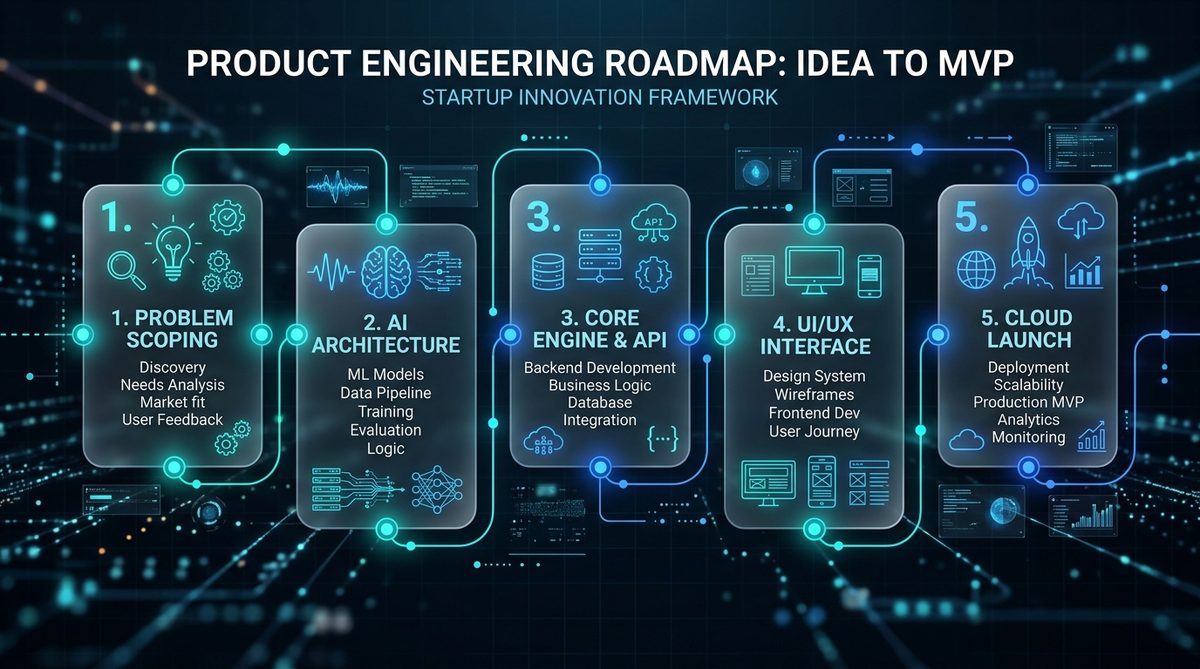
In software development, building an AI Minimum Viable Product (MVP) is fundamentally different from building traditional SaaS.
With traditional software, if code compiles and tests pass, behavior is 100% deterministic. With AI products, your core value proposition often depends on probabilistic model outputs, context retrieval quality, token latency, and dynamic edge cases.
Building an AI MVP isn't about spending six months training a custom model from scratch—nor is it about hacking together a fragile no-code prototype that crashes under the weight of ten concurrent users.
It is about validating the core value hypothesis as quickly and reliably as possible with a clean, scalable architecture that can grow into a multi-million-dollar product.
Here is the exact 10-step engineering process I use to take AI MVPs from raw concept to live production in 2 to 4 weeks.
The 10-Step AI MVP Development Lifecycle
 ┌───────────────────────────────────────────────────────────────────────────┐
 │                        PHASE 1: SCOPING & ARCHITECTURE                    │
 │  1. Problem Scoping ──► 2. Smallest Useful Slice ──► 3. Technical Design  │
 └─────────────────────────────────────┬─────────────────────────────────────┘
                                       │
                                       ▼
 ┌───────────────────────────────────────────────────────────────────────────┐
 │                        PHASE 2: CORE ENGINE & DATA                        │
 │ 4. Model Evaluation ──► 5. Core AI Pipeline ──► 6. Guardrails & Validation│
 └─────────────────────────────────────┬─────────────────────────────────────┘
                                       │
                                       ▼
 ┌───────────────────────────────────────────────────────────────────────────┐
 │                        PHASE 3: FULL-STACK BUILD & LAUNCH                 │
 │ 7. UI/UX Interface ──► 8. Auth & Billing ──► 9. Cloud Deploy ──► 10. Eval │
 └───────────────────────────────────────────────────────────────────────────┘
Step 1: Define the Real Business Problem (Not the AI Gimmick)
Before writing any code, we clarify the exact operational problem:
- What manual task is the user currently doing?
- What is the input format (PDFs, text prompts, CRM records, audio)?
- What is the required output (structured JSON, generated email, database update, dashboard visual)?
- How will we measure success (e.g. 80% time reduction, 95% data extraction precision)?
Step 2: Define the "Smallest Useful Product" (SUP)
Founders frequently try to build 15 features for their v1.0 release: team workspaces, 10 integrations, complex analytics, billing tiers, and multi-agent chats.
I advise stripping the v1 scope down to the single core interaction loop that delivers the "Aha!" moment:
- User provides input.
- AI processes and transforms data accurately.
- User receives the result and exports/acts upon it.
Step 3: Design the Production Architecture
We establish the core stack:
- Frontend & Web App: Next.js 15 (App Router) + TypeScript + Tailwind CSS
- Backend API: FastAPI (Python) for heavy AI orchestration or Next.js Server Actions
- Database & Vectors: PostgreSQL with
pgvector(via Supabase or Neon) - Model Router: Anthropic Claude 3.5 Sonnet / OpenAI GPT-4o with fallback strategies
- Cache & Rate-Limiting: Redis (Upstash)
Step 4: Model Selection & Prompt Benchmark Harness
We don't guess which model works best. We build a rapid test suite with 20 real-world sample inputs:
- Evaluate Claude 3.5 Sonnet vs GPT-4o vs Gemini 1.5 Flash for accuracy, latency, and cost per 1,000 queries.
- Optimize the system prompt with structured few-shot examples and strict schema outputs (using Pydantic / Zod).
// Strict schema validation example in Next.js Server Action
import { z } from 'zod';

const AiAnalysisSchema = z.object({
  summary: z.string(),
  sentiment: z.enum(['positive', 'neutral', 'negative']),
  keyActionItems: z.array(z.string()),
  riskScore: z.number().min(0).max(100),
});

export type AiAnalysis = z.infer<typeof AiAnalysisSchema>;
Step 5: Build the Core AI Engine & Tool Integrations
Whether building a RAG knowledge assistant, an automated document parser, or an agentic workflow:
- Implement semantic chunking and hybrid vector search.
- Connect external APIs (Google Sheets, Stripe, WhatsApp Cloud API, CRMs).
- Ensure all external API calls have timeout boundaries and error retries.
Step 6: Implement Guardrails, Validation & Human-In-The-Loop
In any commercial AI application, edge cases happen. We implement:
- Confidence thresholds: If model confidence falls below 85%, route to a human review queue.
- Math & logic cross-validation: Deterministic Python scripts verify line-item sums, dates, and email formats.
- Rate limiting & anti-abuse: Token bucket algorithms prevent users from spamming the API and draining your token budget.
Step 7: Build a Responsive, High-Performance UI
Modern users expect AI products to feel instantaneous. We build:
- Streaming text responses (Server-Sent Events) for conversational UIs.
- Optimistic UI updates so clicks feel instant.
- Dark mode & clean glassmorphic aesthetic with accessible components (Shadcn/UI).
- Interactive diff view for generated content.
Step 8: Add Authentication, Multi-Tenancy & Stripe Billing
- Authentication: Clerk or Supabase Auth with Google OAuth, magic links, and organization support.
- Tenant Data Isolation: Row-Level Security (RLS) ensures one user can never view or query another user's private data or vector embeddings.
- Subscription Billing: Stripe Checkout with webhook synchronization for usage limits and credit-based token consumption.
Step 9: Cloud Deployment & CI/CD Pipeline
- Deploy the frontend on Vercel with global edge caching.
- Deploy the Python microservice in a containerized environment (Docker on AWS ECS / Render / Modal).
- Configure automated GitHub Actions for linting, type-checking, and build validation on every git push.
Step 10: Instrumentation, User Observability & Fast Iteration
Once live, you must understand how real users interact with the AI:
- Log user prompts, AI outputs, latency, and user feedback (thumbs up / thumbs down) via Langfuse or custom PostgreSQL logs.
- Identify failure patterns in user queries to refine prompts and retrieval embeddings in weekly sprints.
AI MVP Timeline & Deliverables (Typical 3-Week Engagement)
| Timeline | Phase Focus | Key Deliverables | | :--- | :--- | :--- | | Week 1 | Architecture & AI Pipeline | Scoping doc, database schema, prompt harness, core AI microservice. | | Week 2 | Full-Stack UI & Integrations | Next.js 15 web app, streaming interface, Stripe billing, auth setup. | | Week 3 | QA, Hardening & Launch | End-to-end testing, error handling, cloud deployment, analytics setup, live launch. |
Why Work With a Freelance AI Full-Stack Developer?
Hiring a traditional software agency often means dealing with project managers, bloated billable hours, and junior developers executing on cookie-cutter templates.
When working directly with me:
- You communicate directly with the engineer building your product.
- Decisions happen in hours, not weeks.
- Complete code ownership and clean Git history are transferred to your team.
- Built on modern, maintainable industry standards without agency markup.
Turn Your AI Idea Into a Live Product
Building an AI MVP doesn't have to be overwhelming or excessively expensive. With the right architecture and a focused roadmap, you can launch a production-grade product in weeks.
Have an AI SaaS idea or startup project you want to build?
Explore my MVP development services, review my featured projects, or send me a message on WhatsApp to discuss your roadmap and get a direct scope estimate.