
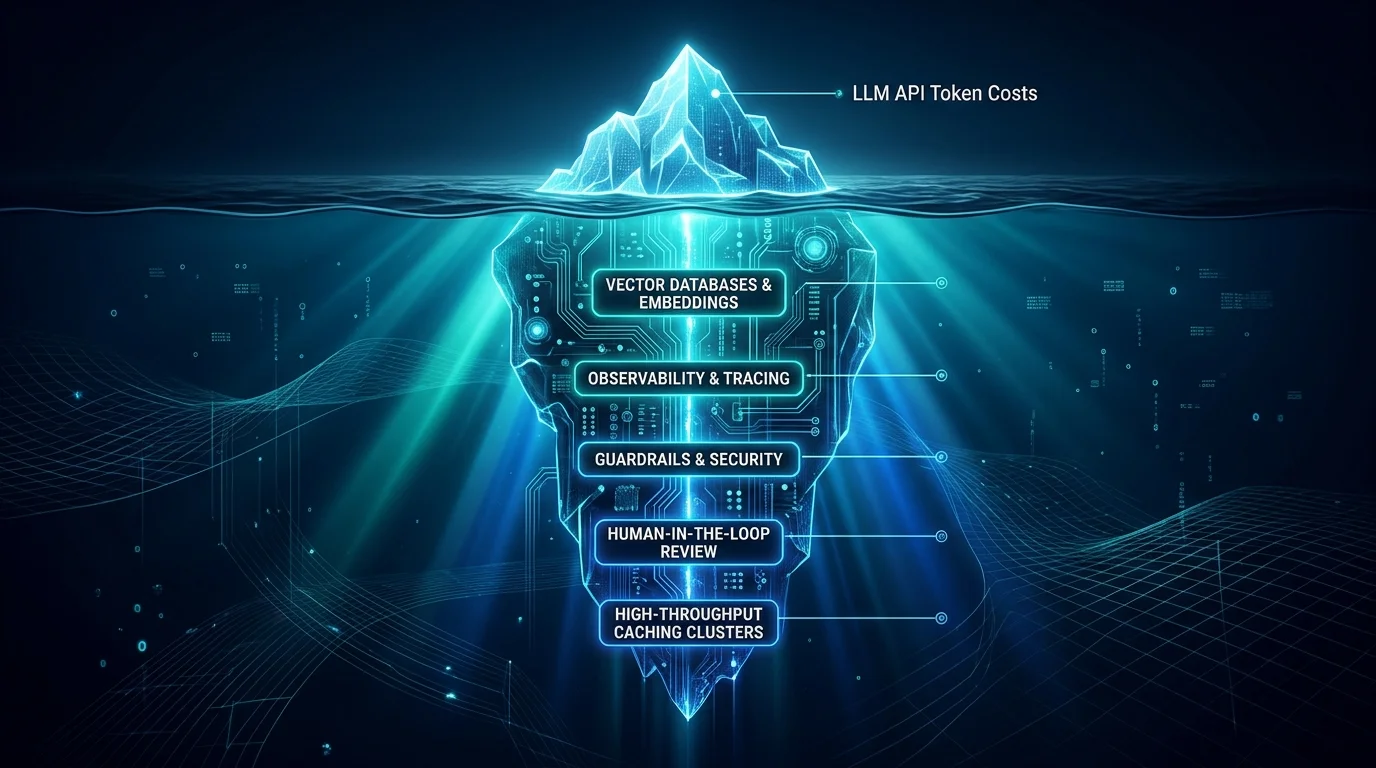
When early-stage founders model the unit economics of an AI product in their financial spreadsheets, they almost always use a simple formula:
$$\text{Estimated Monthly Cost} = (\text{Expected Users} \times \text{Queries per User}) \times \text{Token API Price}$$
They look at OpenAI or Anthropic pricing—$3.00 per million input tokens, $15.00 per million output tokens—and conclude:
"Even with 10,000 monthly active users asking 20 questions each, our direct model API bill will be under $600 a month. Our gross margins will be 85%!"
Then they launch.
Three months in, the actual monthly burn for their AI infrastructure isn't $600. It is $4,800 to $7,500 every single month.
The founders panic, assuming their engineers must have written buggy code or left an unthrottled loop running. But the code is fine. What happened is that the founders fell for the "AI Cost Iceberg": they budgeted exclusively for the visible tip of the iceberg (the LLM token API) while completely ignoring the massive submerged 85% of cloud infrastructure, data pipelines, telemetry, and operational overhead required to make an AI application usable by enterprise customers.
Having architected enterprise document AI pipelines processing 80,000 documents per month at Venture7 and built high-performance SaaS applications for global clients, I have audited multiple production cloud bills.
Here is the unvarnished, line-item truth of where your money actually goes when running an AI business in 2026.
1. The Real Infrastructure Breakdown: The 15/85 Rule
In a production-ready AI SaaS serving paying customers, foundation model API costs typically represent only 15% to 20% of your total technical and operational expenses.
The remaining 80% to 85% is distributed across five non-negotiable categories:
┌────────────────────────────────────────────────────────┐
│  THE VISIBLE 15%:                                      │
│  • Foundation Model Tokens (Anthropic / OpenAI / Bedrock)│
└──────────────────────────┬─────────────────────────────┘
                           │
                           ▼
┌────────────────────────────────────────────────────────┐
│  THE SUBMERGED 85% (HIDDEN REALITY):                   │
│  1. Vector Storage, Embedding Indexing & Hybrid Search  │
│  2. Asynchronous Compute & Background Ingestion Queues │
│  3. Multi-Layer Observability, Logging & Guardrails    │
│  4. Data Storage, Cold Archives & Encryption (S3/KMS)  │
│  5. Human-in-the-Loop Review Seats & Manual Fallbacks  │
└────────────────────────────────────────────────────────┘
2. Line-Item Deep Dive: Where the Submerged 85% Goes
Hidden Cost 1: Vector Storage, Embedding Indexing & Re-Embedding
If your product involves Retrieval-Augmented Generation (RAG), document search, or customer knowledge bases, you rely on a vector database (Pinecone, Weaviate, Qdrant, or AWS pgvector).
Founders budget for the embedding generation (e.g., $0.02 per million tokens on text-embedding-3-small). They forget to budget for:
- Vector Index Hosting: Dedicated pod instances on managed vector databases start at $70 to $250/month per index, scaling rapidly when high availability (HA) and read replicas are enabled for sub-50ms search latency.
- The Re-Embedding Tax: Whenever you upgrade your embedding model (e.g., from an older 1536-dimension model to a newer 3072-dimension model or domain-specific embeddings), you must re-embed your entire customer document library. If you have 500,000 stored pages, every model upgrade incurs a sudden multi-hundred-dollar compute and vector migration spike.
Hidden Cost 2: Preprocessing, PDF Bursting & OCR Compute
Feeding raw documents directly to vision models is economically suicidal. A 50-page scanned PDF requires preprocessing:
- Bursting PDF vectors into rasterized images.
- OpenCV deskewing, auto-contrast, and margin trimming.
- Extracting native text layers via PyMuPDF or Tesseract before deciding if an expensive vision model call is necessary.
This compute does not run on serverless edge functions with 10-second execution caps. It requires dedicated asynchronous container workers (AWS ECS Fargate, Celery worker nodes, and Redis clusters) running 24/7.
Typical Monthly Reality: A modest cluster of two Fargate tasks and a managed Redis instance adds $280 to $450/month before a single customer query reaches Claude or GPT-4o.
Hidden Cost 3: Observability, Tracing & Cost Monitoring
In traditional web applications, checking server logs in Datadog or CloudWatch is relatively straightforward.
In AI applications, debugging why a customer received a hallucinated answer requires deep multi-turn tracing:
- What was the exact prompt template?
- What 5 document chunks were injected by vector search?
- What tool calls did the agent execute, and what were the intermediate JSON arguments?
- How many tokens were consumed at each step?
Using dedicated AI observability platforms (LangSmith, Langfuse, Arize Phoenix) or enterprise Datadog APM tracing typically costs $50 to $300/month depending on trace volume. Attempting to run without observability is impossible: the first time an enterprise client reports an inaccurate financial extraction, you have no way to diagnose what broke.
Hidden Cost 4: The Human-in-the-Loop (HITL) Review Tax
This is the single biggest expense that founders omit from their financial models.
No AI model achieves 100% precision on noisy, real-world customer inputs. In mission-critical workflows—such as invoice processing, legal contract review, or medical triaging—a 95% extraction rate sounds impressive, but it means 5 out of every 100 documents contain an error.
If your platform processes 20,000 invoices a month, 1,000 invoices require human eyes before payment can safely execute.
- Who reviews those 1,000 flagged documents?
- If you hire offshore review specialists at $12/hour, or use an outsourced labeling firm, reviewing 1,000 complex multi-page invoices with discrepancies costs $600 to $1,200 every single month.
- If you use a commercial OCR vendor's built-in validation dashboard, they often charge an extra $100 to $150 per seat per month just for access to their review UI.
If your software architecture does not include an efficient, internal human review queue with bounding-box navigation and keyboard shortcuts, your labor overhead will eat every dollar of your subscription revenue.
3. Real-World Case Study: 50,000 Monthly Transactions Compared
Let's look at the actual monthly P&L comparison for a B2B SaaS processing 50,000 complex documents/queries per month:
| Budget Category | What the Founder Budgeted | The Real Production Bill | | :--- | :--- | :--- | | Foundation Model API Tokens | $750 (GPT-4o / Claude Sonnet) | $1,120 (Accounted for retries & system prompt overhead) | | Asynchronous Compute (ECS + Redis) | $0 (Assumed serverless was free) | $340 (Worker containers & background queues) | | Vector DB Storage & Search | $20 (Embedding API only) | $190 (Pinecone serverless / Pgvector storage & reads) | | Document Storage & Backups (S3 KMS) | $15 | $65 (Encrypted storage of 50K multi-page PDFs) | | Observability & Tracing (LangSmith) | $0 | $90 (Tracing & token cost telemetry) | | HITL Review Queue Infrastructure | $0 | $400 (Internal queue compute + database sync) | | Total Monthly Spend | $785 / month | $2,205 / month | | Percentage Represented by LLM Tokens | 95.5% | Only 50.8% (and dropping as data grows) |
4. How Smart Engineering Teams Slash the Submerged 85%
If you want to maintain healthy 75%+ software margins on an AI product, you must optimize the entire infrastructure stack, not just the prompt.
1. Build an Internal Human-in-the-Loop Queue on Your Primary Database
Never pay $150/month per seat for a proprietary SaaS validation interface. Build your review queue directly into your Next.js application using standard PostgreSQL tables (status: 'PENDING_REVIEW'). This keeps your review workflow 100% free of per-seat SaaS licensing fees.
2. Implement Semantic Caching with Redis
Up to 35% of user questions in customer-facing applications are semantic duplicates (e.g., "How do I reset my password?" vs. "Where can I change my login password?").
By checking incoming queries against a local embedding cache in Redis before dispatching to an LLM, you can return cached answers in sub-20ms while completely eliminating the downstream model API fee for that request.
3. Use Hybrid Search Instead of Massive Vector Indexes
Do not blindly vectorize every single word in your database. Combine BM25 lexical search (PostgreSQL full-text search) with sparse embeddings. This allows you to store fewer dense vectors in RAM, dramatically lowering your monthly database hosting tier.
4. Optimize Image Resolution Before Model Ingestion
When processing images or scanned documents with vision models, resizing a 4,000×3,000 camera photo down to an optimized 1,800×1,200 WebP buffer cuts image token consumption by over 50% without degrading character recognition accuracy by even 0.1%.
5. Summary: What This Means for Founders & Investors
Building an AI SaaS is not merely about renting foundation models; it is about managing data lifecycle economics.
When evaluating an engineering partner or architect to build your AI platform, look for someone who understands the full P&L:
- Do they present you with a comprehensive cloud infrastructure architecture, or do they only talk about prompt engineering?
- Do they have a plan for deterministic caching, asynchronous task offloading, and database indexing?
- Do they design for the inevitable 5% of edge cases where human review is mandatory?
The companies that succeed in the AI era will not be the ones with the cleverest prompts. They will be the ones that engineer the leanest, most reliable systems around those models—turning AI capability into sustainable, high-margin enterprise businesses.
The AI Unit Economics Audit Checklist
| Phase | Metric to Audit | Target Production Benchmark | | :--- | :--- | :--- | | Ingestion | Image/PDF Preprocessing Time | < 600ms per page before model call | | Caching | Semantic Cache Hit Ratio | ≥ 25% of repetitive queries resolved at 0 token cost | | Storage | Vector DB Cost per 10K Documents | < $15 / month via hybrid indexing | | Reliability | Human Review Routing Threshold | < 10% of total volume flagged for human review | | Telemetry | Trace Cost Overhead | < 3% of total cloud infrastructure spend |
Need an architectural audit to cut your AI cloud bills, optimize your vector data pipelines, or scale an enterprise SaaS? Explore My Full-Stack Web Development Services or Book an Engineering Strategy Session.