
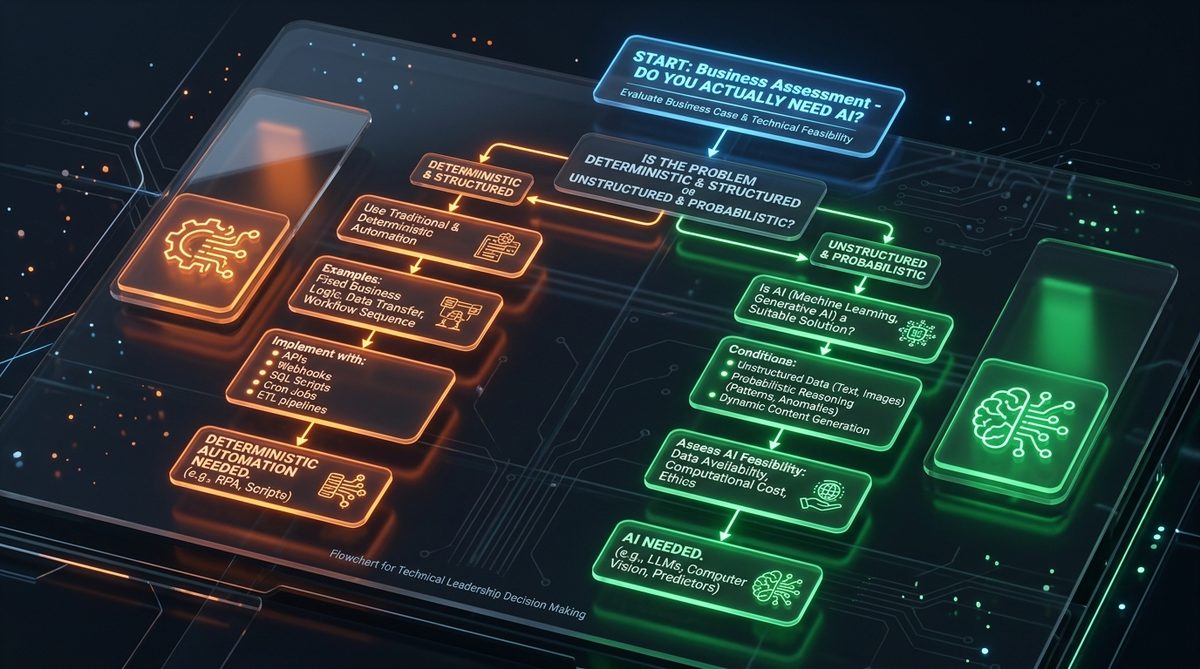
In 2026, AI is the default buzzword in boardrooms and pitch decks. Company executives frequently demand: "We need to add AI to our platform this quarter."
As an AI Engineer and technical consultant, one of the most valuable services I provide to clients is telling them when NOT to use AI.
In approximately 40% of the initial consulting inquiries I receive, the proposed problem does not need an LLM. It needs a well-structured SQL query, a deterministic webhook in n8n, a clean regex parser, or a relational database index.
Using AI for a deterministic problem is like using a helicopter to cross the street: it is expensive, noisy, introduces unnecessary risk of failure, and takes longer than walking.
Here is the exact technical evaluation framework I use to assess AI feasibility, calculate ROI, and determine the optimal technical approach.
1. The Core Feasibility Test: Deterministic vs. Probabilistic
                                  ┌────────────────────────────────┐
                                  │   THE CORE FEASIBILITY TEST    │
                                  └───────────────┬────────────────┘
                                                  │
                                                  ▼
                                   Is the input data unstructured
                                    (messy PDFs, natural speech,
                                      images, open text)?
                                                  │
                         ┌────────────────────────┴────────────────────────┐
                         │                                                 │
                        YES                                                NO
                         │                                                 │
                         ▼                                                 ▼
        Does the task require semantic                    Use Traditional Software
       reasoning, synthesis, or creative                  (SQL, Python Scripts, REST
                 generation?                               APIs, Cron, or Webhooks)
                         │
                ┌────────┴────────┐
                │                 │
               YES                NO
                │                 │
                ▼                 ▼
          USE AI & LLMs     Use Rule Engine
          (Claude/GPT-4o)   (Regex, n8n, OCR)
2. Four Scenarios Where AI is the Wrong Choice
1. Mathematical Computations & Financial Ledger Balancing
- Why AI fails: LLMs are statistical language predictors, not arithmetic calculators. Asking an LLM to add 50 line items directly in text frequently produces off-by-one errors or hallucinated sums.
- The correct approach: Use an LLM only to extract numbers into structured JSON, then use deterministic Python/TypeScript (
math.sum()) to compute totals.
2. High-Frequency, Low-Latency CRUD Workflows
- Why AI fails: If a user clicks a button to update their profile address or change an order status, an LLM call adds 500ms–2000ms of latency and costs money on every click.
- The correct approach: Standard REST APIs and PostgreSQL database transactions.
3. Strict 100% Binary Compliance Rules
- Why AI fails: If a compliance rule states "If state == California and age < 21, reject application", using an LLM leaves a small but real probability of misinterpretation.
- The correct approach: Deterministic boolean if/else logic in your backend service.
4. Simple Form Ingestion with Predictable Layouts
- Why AI fails: If you receive standardized web form submissions or fixed-format CSV files, passing them through an LLM burns tokens for zero added value.
- The correct approach: Standard JSON parsers and SQL batch inserts.
3. Four Scenarios Where AI Delivers Massive ROI
Conversely, when applied to the right problems, AI creates transformational operational leverage:
| Business Problem | Why Traditional Software Fails | Why AI Delivers 10x ROI | | :--- | :--- | :--- | | Multi-Vendor Invoice Processing | Every vendor has a different layout, font, table format, and tax nomenclature. | Multimodal models (Claude Sonnet 5) understand visual layouts and semantic context without custom templates. | | Enterprise Knowledge Search (RAG) | Keyword search fails when users ask questions with synonyms or conceptual queries. | Vector embeddings and hybrid semantic search retrieve precise answers with grounded citations. | | Customer Support Intent & Triage | Rigid regex keyword matchers misclassify nuanced customer complaints. | LLMs accurately categorize sentiment, extract core urgency, and draft contextual responses. | | Complex Unstructured Synthesis | Manual human review of 50-page legal contracts or medical notes takes hours. | LLMs extract key risk clauses and summarize liabilities in seconds. |
4. The 3-Point Business ROI Equation
Before committing budget to an AI project, calculate this simple financial formula:
$$\text{Monthly ROI} = (\text{Hours Saved} \times \text{Hourly Wage}) - (\text{Infrastructure} + \text{API Token Costs})$$
Example Calculation:
- Workflow: Customer support team of 3 agents answering repetitive technical questions.
- Current Manual Cost: 60 hours/month $\times$ $35/hr = $2,100/month.
- AI Solution: Next.js RAG assistant handling 70% of common queries automatically.
- Monthly AI Operating Cost: ~$45 in API tokens + $20 hosting = $65/month.
- Net Monthly Savings: $1,405 / month (plus faster customer resolution times).
If the projected monthly savings or revenue acceleration does not exceed the initial development cost within 3 to 6 months, the project should be rescoped or shelved.
5. How I Run Technical Feasibility Audits
When a company approaches me for AI consulting or full-stack engineering, we conduct a structured Feasibility Discovery:
- Data Audit: We inspect sample inputs (PDFs, transcripts, database exports) to verify quality and consistency.
- Accuracy Tolerance: We define acceptable accuracy thresholds and design Human-in-the-Loop (HITL) safeguards for edge cases.
- Architecture Blueprint: I recommend the leanest technology stack—integrating deterministic automation where possible and AI only where it delivers genuine value.
Get an Honest Evaluation of Your AI Idea
Don't spend thousands on AI hype that doesn't move your business forward. Get a clear, unbiased engineering assessment of your problem.
Considering an AI feature, automation, or custom software application?
Explore my engineering services, review my production case studies, or send me a message on WhatsApp to evaluate your use case.