
When startup founders and business owners decide to hire a freelance software engineer or contract AI specialist, 90% of their attention goes into evaluating resumes, checking GitHub profiles, and running technical interviews.
Then comes the commercial conversation. And this is where projects quietly fall apart before a single line of code is written.
The client wants a guaranteed delivery date and a fixed cost so their budget doesn't explode. The engineer wants protection against unpredictable scope changes, third-party API deprecations, and endless rounds of subjective revisions.
If you pick the wrong contract model:
- Hourly billing creates an adversarial incentive where the engineer is rewarded for working slowly, over-engineering simple problems, and padding timesheets.
- Rigid fixed-price contracts encourage the contractor to cut corners, ignore architecture, and fight over every minor button tweak as an "out-of-scope change order."
Having delivered dozens of high-stakes engineering projects for clients across the United States, the United Kingdom, Dubai, and Australia—spanning enterprise document AI platforms, full-stack Next.js web applications, and autonomous sales bots—I have seen firsthand which contracting models protect both sides and which lead to lawsuits and abandoned codebases.
Here is an unvarnished guide to how founders and engineering leaders should structure their freelance AI contracts in 2026.
1. The Breakdown of the Three Primary Contracting Models
To choose the right framework, you must understand the underlying psychological and economic incentives of each structure.
Model 1: Traditional Hourly Billing
In this model, the client pays a set rate per hour logged (e.g., $50/hr to $150/hr), usually tracked via software like Upwork time-trackers, Toggl, or weekly invoice submissions.
- Where it works: Open-ended maintenance, bug triaging on legacy codebases, part-time advisory roles, or ad-hoc technical support where the scope changes daily.
- The Fatal Flaw in AI & Systems Engineering: In software architecture, four hours of thoughtful design can save four weeks of debugging. Under hourly billing, an elite senior engineer who solves a critical database bottleneck in two hours makes $200. A junior engineer who spends 40 hours struggling through Stack Overflow and writing fragile spaghetti code bills $2,000.
- The Result for Founders: You have zero budget predictability. You live in constant fear of opening Monday's invoice and seeing an extra 35 hours billed because "the LangChain memory vector store took longer than expected to configure."
Model 2: The Monolithic Fixed-Price Project
The client provides a requirements document, the freelancer quotes a single flat price (e.g., "$12,000 for the entire AI MVP"), and payment is tied to final delivery.
- Where it works: Highly standardized, cookie-cutter deliverables (e.g., configuring an established WordPress site or setting up a standard Shopify store) where requirements are 100% frozen.
- The Fatal Flaw in AI Products: Building an AI product is an iterative scientific process. You do not know ahead of time how an LLM will react to real customer inputs, or whether a specific chunking strategy will cause hallucinations until you test it against live documents.
- The Result for Founders: When the contractor realizes the project requires twice as much work as estimated, they face a painful choice: work for free or rush the delivery. Quality collapses, technical debt accumulates, and the relationship degrades into hostile arguments over the definition of "done."
Model 3: The 2-Week Milestone Sprint (The Gold Standard)
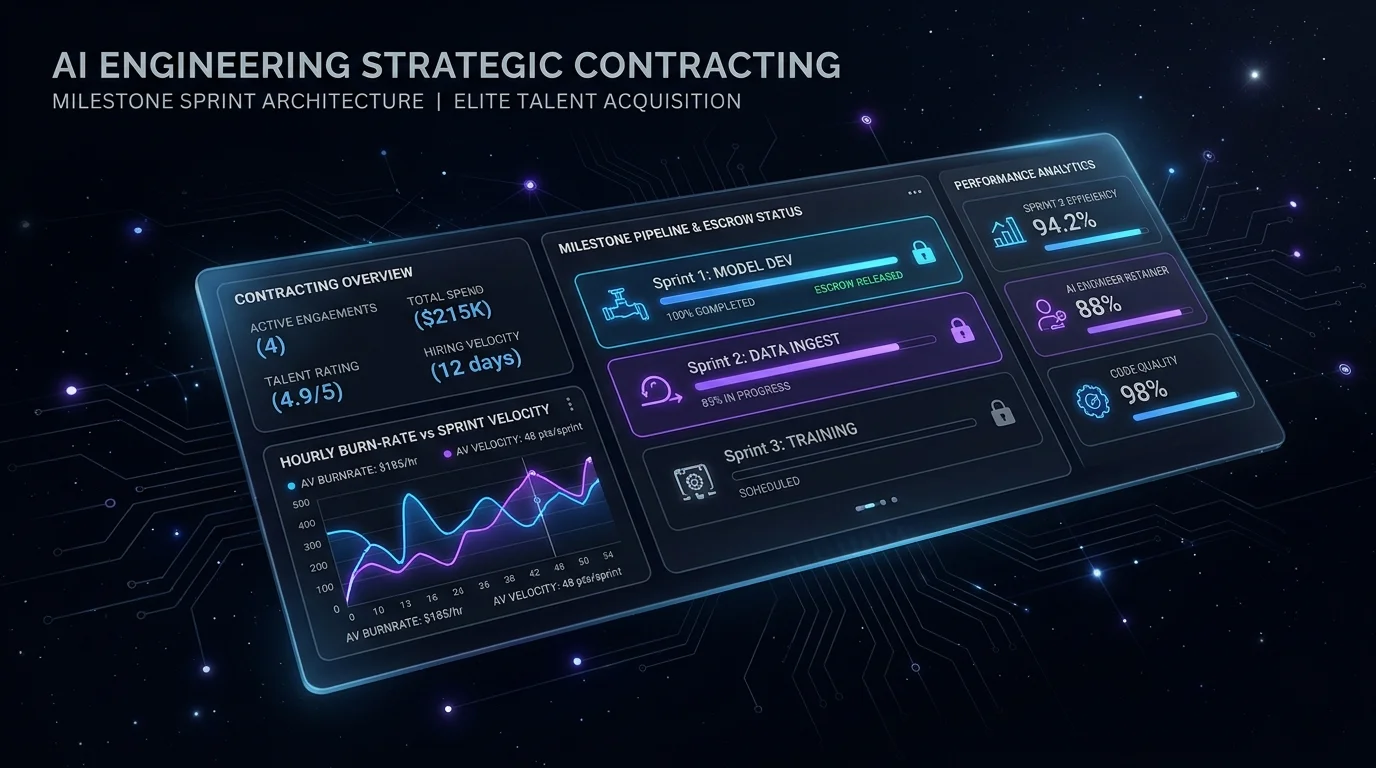
The project is decoupled into discrete, autonomous two-week sprint deliverables. Each sprint has a locked scope, an agreed flat fee, explicit acceptance criteria, and escrow funding.
- Where it works: AI MVPs, complex web platforms, SaaS dashboards, and autonomous agent pipelines.
- Why it wins: It aligns incentives perfectly. The founder gets predictable bi-weekly budgets and working software in two-week intervals. The engineer gets protected focus, zero unpaid scope creep, and prompt payments upon milestone verification.
2. Head-to-Head Comparison: Which Model Fits Your Project?
| Contracting Dimension | Hourly Billing | Monolithic Fixed-Price | 2-Week Milestone Sprints | | :--- | :--- | :--- | :--- | | Budget Predictability | Extremely Low (Open-ended) | High initially (Subject to renegotiation) | Guaranteed per 2-week cycle | | Incentive Alignment | Rewarded for slowness & bloat | Rewarded for cutting corners | Rewarded for rapid, high-quality completion | | Flexibility for Changes | High (but costs you every hour) | Zero (Every tweak requires a change order) | Agile: Scope adjusts between sprints | | Financial Risk to Founder | High (Cost overruns) | Medium (Vendor abandonment risk) | Low (Escrow funded one sprint at a time) | | Visibility into Progress | Weekly timesheets (Often opaque) | Often radio silence until final demo | Live staging demo every 14 days |
3. The Blueprint for a Successful 2-Week Milestone Sprint
When I work with international founders, we structure contracts around a transparent 3-to-4 sprint roadmap. Here is what a typical engagement looks like:
[ Discovery & Architectural Scoping: 2 Days ]
                      │
                      ▼
┌────────────────────────────────────────────────────────┐
│     SPRINT 1: Core Foundation & Data Pipeline          │
│  • Fast Schema Setup & PostgreSQL Database             │
│  • Ingestion & OCR/Preprocessing Layer                 │
│  • Deliverable: Staging API with verified test cases   │
└─────────────────────┬──────────────────────────────────┘
                      │ Live Demo & Code Review
                      ▼
┌────────────────────────────────────────────────────────┐
│     SPRINT 2: LLM Engine & Business Logic Layer        │
│  • Multi-agent orchestration / Claude Sonnet Prompts   │
│  • Fallback validation & confidence scoring            │
│  • Deliverable: Working end-to-end backend pipeline    │
└─────────────────────┬──────────────────────────────────┘
                      │ Live Demo & Feedback Session
                      ▼
┌────────────────────────────────────────────────────────┐
│     SPRINT 3: Frontend Interface & Production Launch   │
│  • Next.js 15 UI, review dashboard & analytics         │
│  • CI/CD deployment to Vercel/AWS & documentation      │
│  • Deliverable: Full production deployment & handoff   │
└────────────────────────────────────────────────────────┘
Why Escrow-Backed Sprints Protect Both Parties
- For the Founder: You never pay for an entire project upfront. You fund only Sprint 1 into an escrow account (or milestone contract). If the engineer fails to deliver the promised acceptance criteria at the end of the two weeks, you can terminate the contract with minimal loss. You are never held hostage.
- For the Engineer: The developer knows the funds are guaranteed and deposited before writing code. They don't have to chase invoices or worry about non-payment after delivering high-value work.
4. The 5 Contract Clauses Every AI Project Must Include
Whether you hire through Upwork, a direct B2B contract, or an independent milestone agreement, ensure your contract includes these five non-negotiable clauses:
1. Clear Intellectual Property (IP) Ownership on Payment
The contract must explicitly state that all source code, proprietary prompts, database schemas, and documentation become the 100% exclusive property of the client immediately upon payment release of each milestone. Beware of contractors who attempt to retain licensing rights over core application logic.
2. Third-Party API & Cloud Infrastructure Costs
Make it unambiguous that all third-party usage costs—Anthropic/OpenAI token bills, Pinecone vector storage, AWS hosting, and domain fees—are the direct financial responsibility of the client. The client should provide access to dedicated API keys within an isolated developer organization. Never allow a freelancer to host your production LLM traffic under their personal API account.
3. Explicit Acceptance Criteria
A milestone description should never say: "Work on backend AI features."
It must state:
"Sprint 2 Acceptance Criteria: Deploy a FastAPI endpoint accepting PDF uploads up to 15MB, extracting line items with a verified test precision of ≥ 95% on the agreed 20-sample validation dataset, returning structured JSON responses in under 4.0 seconds."
When acceptance criteria are measurable, subjective arguments disappear.
4. Code Quality & Architecture Standards
Mandate that deliverables must include:
- Clean Git commit histories with sensible semantic messages (
feat:,fix:,refactor:). - A self-contained
README.mdwith local Docker setup instructions. - Zero hardcoded credentials or API keys (enforcing
.envvariable patterns).
5. A 14-Day Post-Launch Warranty Period
A top-tier engineer will stand behind their work. Ensure your final sprint includes a 14-day warranty window where bug fixes for features that deviate from agreed specifications are resolved at zero additional charge.
5. Summary: How to Get the Highest Value from Top Freelance Engineers
Top freelance engineers in 2026 do not want to be micromanaged on a time-tracking widget, and they do not want to bid against low-cost agencies in a race to the bottom on fixed-price gig platforms.
They want to work as trusted technical partners:
- Give them a clear business problem to solve.
- Define explicit milestone goals with measurable outcomes.
- Pay them fair market rates promptly upon verified milestone delivery.
- Treat communication with professional respect and fast feedback cycles.
When you structure your contracts around mutually respectful 2-week milestone sprints, you attract the top 5% of software engineers—and you ship robust, production-ready AI products on time and on budget.
Quick Reference Contracting Decision Matrix
| Situation | Recommended Contract Model | Typical Payment Structure | | :--- | :--- | :--- | | Building a New AI MVP or SaaS (0 to 1) | 2-Week Milestone Sprints | $2,500 – $5,000 per sprint (Escrow) | | Replacing SaaS OCR with In-House Pipeline | 2-Week Milestone Sprints | 2 Sprints (Pipeline + ERP Integration) | | Ongoing Maintenance & Minor Bug Fixes | Monthly Retainer or Hourly | 10–20 hours/month reserve pool | | Advisory / Architecture Code Review | Day Rate or Fixed Audit Fee | Single milestone upon report delivery |
Looking for a battle-tested engineering partner to architect your Next.js application, build custom AI agent workflows, or replace high-cost SaaS tools? View My Available Services or Discuss Your Project Scope.