
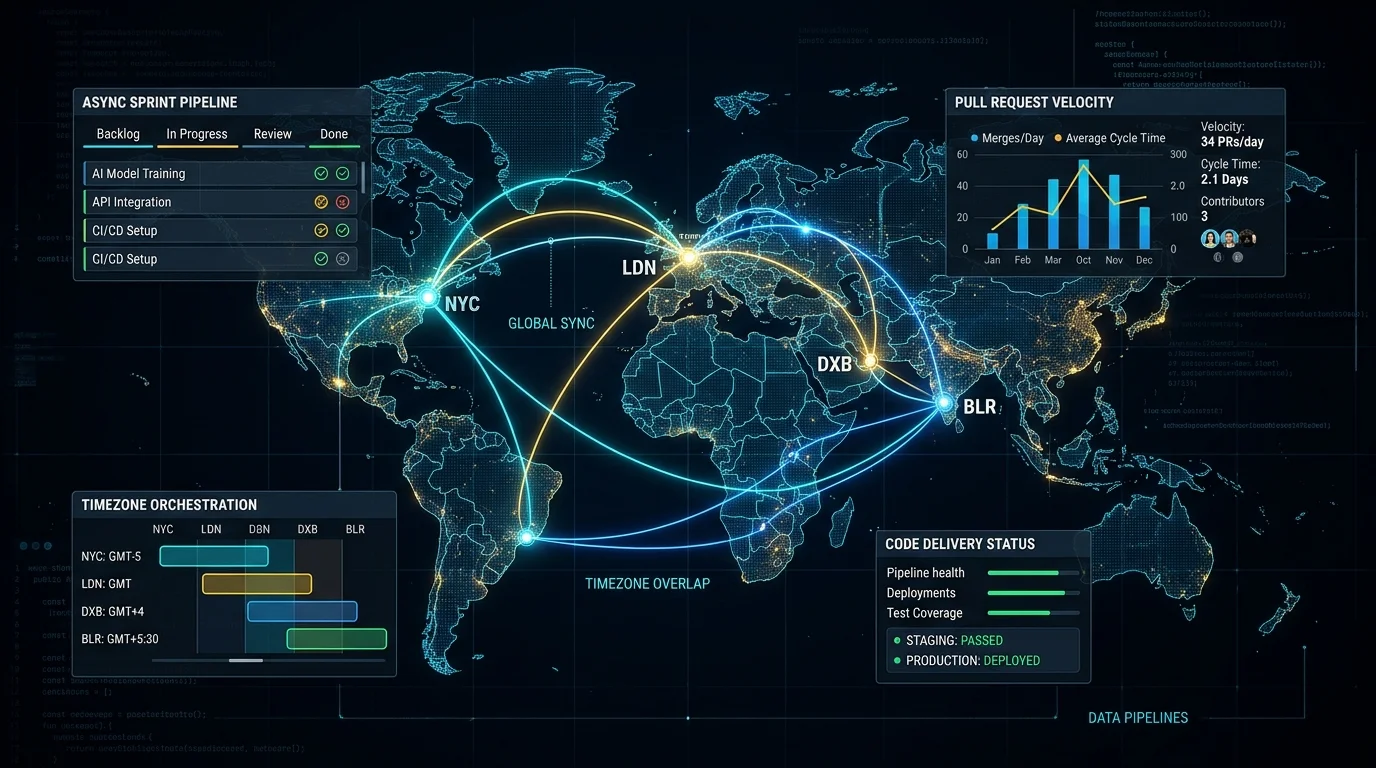
For venture-backed startups and growing businesses in the United States, the United Kingdom, Europe, and Australia, hiring technical talent is the single biggest operational bottleneck.
In San Francisco or New York, hiring a senior full-stack or AI engineer frequently commands a base salary of $180,000 to $260,000, plus equity, healthcare, and recruiting agency fees. Even contract rates easily reach $140 to $220 per hour. For early-stage startups and lean agencies, burning through capital at that velocity severely limits runway.
Naturally, founders look globally. And India represents the largest, deepest pool of technical engineering talent in the world.
Yet, when you speak candidly with international founders who have tried hiring in India, you hear two completely opposite stories:
- Founder A: "It was a disaster. I hired an agency, the code was a copy-pasted mess, they disappeared whenever an edge case appeared, and the 10-hour timezone difference meant we wasted two days just exchanging messages on Slack."
- Founder B: "It is our company's unfair advantage. Our lead remote engineer in India operates with complete autonomy, delivers production code while our US team sleeps, joins our daily overlap syncs, and has saved us over $120,000 a year while shipping faster than our local hires."
Why is the variance so extreme?
Because India has two completely different engineering ecosystems, and most founders do not know how to tell them apart until they have already lost three months and $15,000.
Having collaborated directly with founders and product teams across North America, London, and Dubai—co-building enterprise document processing systems, scalable Next.js web applications, and autonomous agent backends—I want to share the practical, unvarnished playbook for how international founders can hire and collaborate with top-tier remote engineers in India without friction.
1. The Two Engineering Worlds of India
To succeed, you must understand the distinction between the Legacy Outsourcing Factory and the Independent Systems Architect.
┌────────────────────────────────────────────────────────┐
│           THE LEGACY OUTSOURCING FACTORY               │
│  • 500-person agency with account managers in between  │
│  • Junior coders following rigid ticket instructions   │
│  • Yes-men culture: Never challenges bad client specs  │
│  • Rates: $15 - $25/hr (Billed cheap, costs you triple)│
└────────────────────────────────────────────────────────┘
                           VS
┌────────────────────────────────────────────────────────┐
│         THE INDEPENDENT SYSTEMS ARCHITECT              │
│  • Top 1-5% senior full-stack / AI systems specialists │
│  • Direct engineer-to-founder communication (No middlemen)│
│  • High-context: Challenges architecture & optimizes P&L│
│  • Rates: $45 - $85+/hr (Clean code, zero technical debt)│
└────────────────────────────────────────────────────────┘
The Legacy Factory Model
These are large IT outsourcing shops or generic gig-economy agencies. They win business by quoting unsustainably low hourly rates ($15 to $25/hr).
To make a profit, they assign your project to junior developers who are juggling four other client codebases simultaneously. They operate in a strict "ticket-taking" culture: if you ask for a feature that is technically flawed or economically unfeasible, they will never push back or suggest a better path. They will simply say "Yes, sir" and write fragile code that breaks the moment real users arrive.
The Independent Systems Architect
These are elite, self-directed engineers who work directly with founders as strategic technical partners. They have shipped real production applications, contributed to open-source software, published peer-reviewed research, or architected high-throughput microservices.
They do not just write code; they think like product owners:
- "You asked for an autonomous multi-agent swarm, but a simple deterministic API with a PostgreSQL cache will solve this 10x faster and save you $800 a month in tokens."
- "Your database schema will bottleneck once you pass 10,000 users; let's restructure this index now before we launch."
When you partner with an independent systems architect, the geographic distance becomes entirely irrelevant.
2. Solving the Timezone Challenge: The 4-Hour Overlap System
The most common fear among US and European founders is the timezone gap:
- San Francisco (PST): 12.5 to 13.5 hours behind India Standard Time (IST).
- New York (EST): 9.5 to 10.5 hours behind IST.
- London (GMT): 4.5 to 5.5 hours behind IST.
Amateur teams view this as an obstacle. High-performing teams turn this into a 24-hour continuous development engine.
Here is how our daily collaboration cadence works with US and international clients:
YOUR MORNING (9:00 AM EST)
• You wake up and review:
  - Clean GitHub pull request waiting in your repository
  - 3-minute Loom video demo showing the new feature in action
  - Concise async summary on Slack / Linear

OUR OVERLAP WINDOW (10:00 AM - 1:00 PM EST / 7:30 PM - 10:30 PM IST)
• Live 20-minute architectural sync (if needed)
• Fast Slack back-and-forth for immediate clarifications
• Unblocking dependencies and approving PR merges

YOUR AFTERNOON (2:00 PM - 5:00 PM EST)
• Your team runs user tests, gives feedback, or focuses on marketing/sales

OUR DELIVERY WINDOW (OVERNIGHT IN US)
• Dedicated, uninterrupted deep-work focus in India
• Zero daytime meeting interruptions
• Code pushed and staged before your next morning begins
By maintaining a guaranteed 3 to 4-hour daily overlap window (typically matching the US morning or European afternoon), you get all the benefits of real-time collaboration without forcing anyone to work nocturnal schedules that degrade cognitive performance.
3. The 3 Async Communication Standards of Elite Engineers
Top remote engineers do not expect you to hop on a Zoom call for every minor decision. They communicate using three high-leverage asynchronous primitives:
1. The 3-Minute Loom Video Walkthrough
Whenever a significant feature, UI interaction, or backend pipeline is finished, the engineer records a brief screen walkthrough:
- Shows the feature running on a live staging environment.
- Demonstrates edge-case behavior (e.g., how the app handles invalid file formats or network timeouts).
- Points out the specific files changed in the pull request.
The Result: The founder can watch the demo at 1.5x speed with their morning coffee, verify the deliverable in three minutes, and avoid a 45-minute status meeting.
2. High-Context Async Writing Over Slack Pings
Instead of sending low-context interruptions like:
"Hey, quick question about the database..." (which forces the founder to stop what they are doing and ask "What about it?"),
an elite remote engineer writes structured, decision-ready memos:
"Regarding the invoice storage requirement: AWS S3 with KMS encryption gives us compliance at $0.023/GB, whereas storing PDFs in PostgreSQL blobs will bloat our database backups. I recommend S3. If you approve, I'll proceed with this architecture; if you prefer DB storage for a specific reason, let me know by 2 PM EST."
This allows the founder to reply with a single word ("Approved") and keep the project moving forward at maximum velocity.
3. Transparent, Semantic Git Hygiene
You should never have to ask your engineer: "What did you do today?"
The answer should be self-evident in your GitHub repository:
- Descriptive branch names (
feat/invoice-pydantic-validation,fix/sub-second-lcp). - Semantic commit messages with clear context.
- Automated CI/CD deployments where every merged PR automatically updates the live staging URL.
4. How to Structure Fair, High-Trust Commercial Relationships
If you want an elite remote engineer to prioritize your startup, treat the commercial relationship with maturity:
1. Pay Competitive Global Market Rates
Do not look for the absolute cheapest freelancer on a bidding platform. The difference between a $20/hr developer who leaves you with unmaintainable spaghetti code and a $60/hr senior engineer who builds an ironclad enterprise architecture is not 3x in cost—it is 10x in long-term business value.
Top freelance AI and full-stack engineers in India working directly with international startups typically charge $45 to $85+ per hour, or $2,500 to $5,000 per 2-week sprint. At these rates, the founder saves 60% compared to Western contractor prices, while the engineer receives excellent, market-leading compensation that commands their total dedication.
2. Use 2-Week Milestone Sprints with Escrow
Never ask an engineer to work for four weeks on an invoice that you might pay 30 days later, and never pay 100% of a project cost upfront. Fund two-week milestone sprints into escrow. When the sprint acceptance criteria are verified on staging, release the payment immediately. Trust is built through predictable, reliable actions.
3. Share the "Why," Not Just the "What"
Give your engineer visibility into your business goals:
- Why does this enterprise customer care about sub-3-second latency?
- What are the conversion goals for this landing page?
- What is the feedback from your sales demos?
When a high-caliber engineer understands the underlying commercial objective, they stop being a transactional contractor and become an invaluable technical partner.
5. Summary: Building Your Global Engineering Engine
The world of software development has permanently decoupled from physical office locations.
The startups that scale the fastest in 2026 will not be the ones with the largest local payrolls in expensive tech hubs. They will be the ones that master global remote talent orchestration:
- Finding high-caliber, high-context independent systems engineers.
- Establishing disciplined async communication habits and daily overlap windows.
- Structuring fair, milestone-backed contracts that incentivize speed, architecture, and accountability.
When done right, you don't just cut your development burn rate in half—you build a resilient, 24-hour engineering engine that ships world-class software while your competitors are still stuck in traffic.
Founder's Remote Collaboration Rubric
| Dimension | Low-Trust Outsourcing (Failure) | High-Trust Strategic Partnership (Success) | | :--- | :--- | :--- | | Communication | Endless Zoom calls & passive Slack pings | 3-min Loom videos & structured async decision memos | | Overlap Cadence | Complete timezone mismatch & missed days | Guaranteed 3–4 hour daily overlap window | | Code Visibility | Infrequent zip files or unreviewed code | Daily semantic Git commits & automated staging deploys | | Problem Solving | Blindly follows instructions even if flawed | Proactively challenges architecture & cuts cloud waste | | Contract Model | Vague hourly timesheets with cost overruns | 2-Week milestone sprints with explicit acceptance criteria |
Looking for an elite, autonomous AI & full-stack engineer with proven US/UK timezone overlap experience and enterprise delivery? Explore My Case Studies or Reach Out Directly for a Discovery Call.