
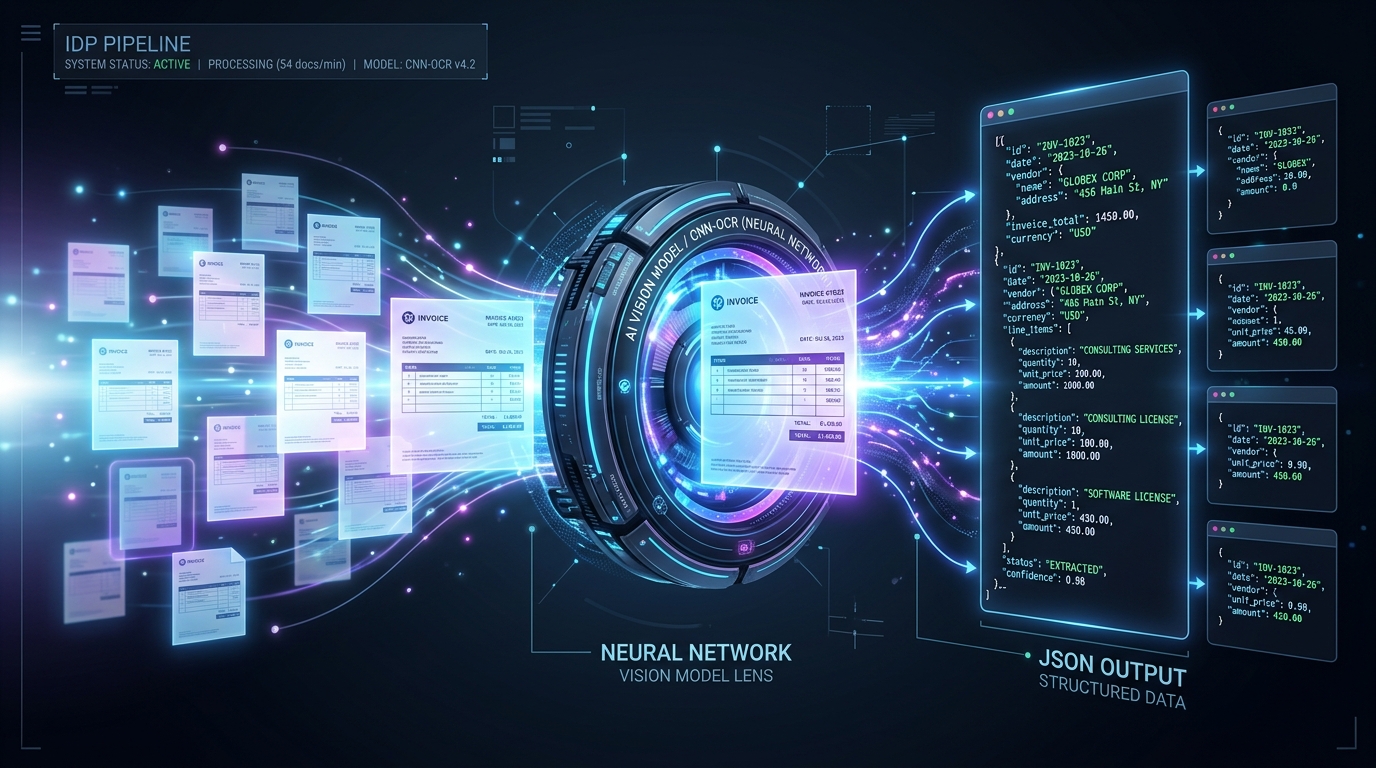
When an enterprise scales past 50,000 invoices, bills of lading, and purchase orders per month, proprietary SaaS OCR vendors—such as Nanonets, ABBYY, or AWS Textract with customized schemas—quickly turn into an aggressive line-item cost. Beyond standard tier pricing of $0.05 to $0.15 per document page, teams hit a harder wall: opaque model hallucinations, rigid template retraining, and zero ability to inject custom business reasoning without filing vendor support tickets.
Over the past year at Venture7 Technologies, co-building an enterprise-grade Intelligent Document Processing (IDP) platform processing ~80,000 documents per month (over 55,000 multi-vendor invoices, POs, and statements) for a US client, our team executed a complete migration away from a legacy Nanonets OCR setup to an in-house Python pipeline orchestrated around Claude Sonnet 3.5, deterministic pre-processing heuristics, and dynamic vendor rule matching.
The result? A 70% reduction in direct processing costs, an increase in extraction field accuracy from 89.2% to 98.4%, and sub-3-second average latency.
Here is the complete engineering architecture, code implementation, and lessons learned from production.
The Economic & Architectural Bottleneck of Legacy OCR
Traditional OCR platforms rely on a two-step paradigm:
- Geometric Tokenization: A convolutional OCR engine (Tesseract, proprietary CNNs) locates character bounding boxes $(x, y, w, h)$.
- Template or Heuristic Key-Value Association: A rule set or spatial NLP model attempts to link words near each other (e.g., mapping
"Invoice Total"to the dollar amount directly below or to the right).
This paradigm crumbles in multi-vendor enterprise environments for three predictable reasons:
- Spatial Drift: Vendor A prints the total below the line items on page 1; Vendor B prints it on page 4; Vendor C has multiple sub-totals with conditional equipment rental discounts.
- Table Line Wrapping: When a line item description wraps across three physical lines without border dividers, heuristic clustering merges adjacent rows, corrupting unit price arithmetic.
- Opaque Retraining Cycles: Retraining a commercial black-box model requires hundreds of manually annotated sample PDFs and weeks of turnaround, yet fails on the next novel supplier invoice format.
The Cost Comparison at Scale (80K Documents / Month)
| Architecture Stage | Commercial OCR SaaS (Nanonets Tier) | In-House Claude Sonnet 3.5 + Python Pipeline | | :--- | :--- | :--- | | Base Page Cost | $0.08 / page ($6,400 / mo) | $0.003 / image token + $0.015 / 1K output tokens (~$1,850 / mo) | | Custom Rule Logic | Vendor add-on fees / rigid config | Free, version-controlled Markdown rules per vendor | | HITL Review Routing | Locked to proprietary dashboard | Embedded Angular/React queue with custom database triggers | | Total Monthly Run-Rate | ~$7,200 – $9,000 / mo | ~$2,100 – $2,600 / mo (71% savings) |
System Architecture Overview
Our production pipeline operates across five decoupled stages:
┌────────────────────────────────────────────────────────────────────────┐
│                   STAGE 1: DOCUMENT PREPROCESSING & PDF SPLIT          │
│   • Multi-page PDF burst into high-fidelity WebP images (300 DPI)      │
│   • Grayscale normalization, deskewing & whitespace crop               │
└───────────────────────────────────┬────────────────────────────────────┘
                                    │ Preprocessed Page Images
                                    ▼
┌────────────────────────────────────────────────────────────────────────┐
│               STAGE 2: SELLER IDENTIFICATION & DYNAMIC RULES           │
│   • Fast OCR heuristic regex or lightweight embedding match            │
│   • Load vendor-specific Markdown logic from Git/Vector DB             │
└───────────────────────────────────┬────────────────────────────────────┘
                                    │ Image + Vendor Markdown Heuristics
                                    ▼
┌────────────────────────────────────────────────────────────────────────┐
│            STAGE 3: CLAUDE SONNET 3.5 STRUCTURED VISION EXTRACTION    │
│   • Schema enforcement via Pydantic & Instructor/Native JSON           │
│   • Line item breakdown, tax adjustments, currency ISO codes           │
└───────────────────────────────────┬────────────────────────────────────┘
                                    │ Raw Extracted JSON Payload
                                    ▼
┌────────────────────────────────────────────────────────────────────────┐
│              STAGE 4: DETERMINISTIC MATHEMATICAL VALIDATION            │
│   • Arithmetic audit: Σ(Line Totals) + Tax - Discounts == Net Total   │
│   • Regex currency & date standardization (ISO-8601)                  │
│   • Confidence threshold scoring per critical field                   │
└───────────────────────────────────┬────────────────────────────────────┘
                                    │ Scored Document
                   ┌────────────────┴────────────────┐
                   │ Confidence >= 95%               │ Confidence < 95%
                   ▼                                 ▼
   ┌──────────────────────────────┐  ┌──────────────────────────────────┐
   │ Auto-Ingest into ERP / CRM   │  │ Route to HITL Angular Reviewer  │
   │ (Business Central / SFDC)    │  │ (Field-level manual approval)   │
   └──────────────────────────────┘  └──────────────────────────────────┘
1. High-Performance Preprocessing in Python
One of the costliest mistakes when calling vision LLMs is sending unoptimized, full-color 30MB PDFs. High-resolution color photographs waste input tokens on background wood grain, shadows, and margins without improving character contrast.
We normalize incoming PDFs with pdf2image and Pillow, converting pages into optimized 300 DPI WebP buffers:
import io
from typing import List
from PIL import Image, ImageOps
import fitz  # PyMuPDF

def preprocess_pdf_pages(pdf_bytes: bytes, max_dpi: int = 300) -> List[bytes]:
    """
    Renders PDF pages into optimized, contrast-enhanced grayscale WebP images
    to minimize Claude Sonnet token cost while maximizing OCR legibility.
    """
    doc = fitz.open(stream=pdf_bytes, filetype="pdf")
    processed_pages = []

    for page_num in range(len(doc)):
        page = doc[page_num]
        # Calculate zoom matrix for crisp 300 DPI
        zoom = max_dpi / 72.0
        matrix = fitz.Matrix(zoom, zoom)
        pix = page.get_pixmap(matrix=matrix, alpha=False)

        # Convert to PIL Image
        img = Image.open(io.BytesIO(pix.tobytes("png")))

        # Convert to Grayscale & Auto-contrast
        img_gray = ImageOps.grayscale(img)
        img_contrast = ImageOps.autocontrast(img_gray, cutoff=2)

        # Encode to WebP buffer with quality tuning
        buffer = io.BytesIO()
        img_contrast.save(buffer, format="WEBP", quality=85, method=6)
        processed_pages.append(buffer.getvalue())

    return processed_pages
2. Dynamic Vendor Markdown Logic: The Secret Weapon
In generic document AI, developers send a generic prompt: "Extract the invoice line items."
The LLM gets confused when Vendor A labels their equipment surcharge as "ENV SURCH" or when Vendor B groups multiple shipments under single line summaries.
Instead of retraining models, we engineered a Dynamic Seller Rules Engine. We store Markdown files for recurring suppliers. For example, vendors/globex_logistics.md:
# Vendor Rules: Globex Logistics Corp
- Primary Currency: USD
- Invoice Number Format: Prefixed with "GLX-" followed by 8 digits.
- Line Items: Ignore "FUEL SURCHARGE SUMMARY" as a line item; it must be mapped to `fuel_surcharge` field.
- Total Calculation: The true total is marked as "NET REMITTANCE", NOT "GROSS BILLED".
When a document arrives, a rapid header heuristic identifies the vendor name and injects this specific Markdown block into the Claude system prompt:
import base64
from anthropic import Anthropic
from pydantic import BaseModel, Field
from typing import List, Optional

class InvoiceLineItem(BaseModel):
    description: str
    quantity: float
    unit_price: float
    line_total: float

class ExtractedInvoice(BaseModel):
    invoice_number: str
    invoice_date: str = Field(description="ISO-8601 date string YYYY-MM-DD")
    vendor_name: str
    currency: str = Field(description="3-letter ISO code e.g. USD, EUR, CAD")
    subtotal: float
    tax_amount: float
    discount_amount: Optional[float] = 0.0
    total_amount: float
    confidence_score: float = Field(description="Self-evaluated certainty between 0.0 and 1.0")
    line_items: List[InvoiceLineItem]

def extract_invoice_with_claude(
    image_bytes: bytes,
    vendor_markdown_rules: Optional[str] = None
) -> ExtractedInvoice:
    client = Anthropic()
    encoded_image = base64.b64encode(image_bytes).decode("utf-8")

    system_prompt = (
        "You are an elite enterprise financial OCR engine. "
        "Extract all financial, vendor, and line item entities with 100% precision. "
        "Adhere strictly to the requested JSON schema. Do not guess or interpolate."
    )

    if vendor_markdown_rules:
        system_prompt += f"\n\nVENDOR-SPECIFIC BUSINESS HEURISTICS:\n{vendor_markdown_rules}"

    response = client.beta.messages.create(
        model="claude-3-5-sonnet-20241022",
        max_tokens=4096,
        system=system_prompt,
        messages=[
            {
                "role": "user",
                "content": [
                    {
                        "type": "image",
                        "source": {
                            "type": "base64",
                            "media_type": "image/webp",
                            "data": encoded_image,
                        },
                    },
                    {
                        "type": "text",
                        "text": "Extract all structured invoice fields into strict JSON matching the schema.",
                    },
                ],
            }
        ],
    )

    raw_text = response.content[0].text
    # Parse into typed Pydantic structure
    return ExtractedInvoice.model_validate_json(raw_text)
3. Deterministic Arithmetic Validation & HITL Routing
LLMs must never be trusted blindly with corporate bank transactions. Even Claude Sonnet 3.5 can occasionally misread a faded decimal point ($1,005.00 vs $100.50).
To guarantee 100% accounting safety, we pass the parsed Pydantic object through a Deterministic Validation Gate:
from decimal import Decimal

def validate_invoice_arithmetic(invoice: ExtractedInvoice, tolerance: Decimal = Decimal("0.05")) -> tuple[bool, str]:
    """
    Verifies that the sum of line items matches subtotal and net total
    within rounding tolerance.
    """
    subtotal = Decimal(str(invoice.subtotal))
    tax = Decimal(str(invoice.tax_amount))
    discount = Decimal(str(invoice.discount_amount or 0.0))
    total = Decimal(str(invoice.total_amount))

    # Calculate sum of lines
    computed_subtotal = Decimal("0.0")
    for item in invoice.line_items:
        line_qty = Decimal(str(item.quantity))
        line_price = Decimal(str(item.unit_price))
        computed_line = line_qty * line_price

        # Verify line-level arithmetic
        if abs(computed_line - Decimal(str(item.line_total))) > tolerance:
            return False, f"Line item '{item.description}' arithmetic mismatch."

        computed_subtotal += Decimal(str(item.line_total))

    # Verify subtotal vs lines
    if abs(computed_subtotal - subtotal) > tolerance:
        return False, f"Sum of line items ({computed_subtotal}) does not match subtotal ({subtotal})."

    # Verify grand total
    computed_grand_total = subtotal + tax - discount
    if abs(computed_grand_total - total) > tolerance:
        return False, f"Computed grand total ({computed_grand_total}) does not match reported total ({total})."

    return True, "Arithmetic perfectly verified."
The Confidence Routing Decision
- If arithmetic passes AND confidence $\ge 0.95$: The document automatically commits into Microsoft Dynamics 365 Business Central and Salesforce via REST webhooks.
- If arithmetic fails OR confidence $< 0.95$: The document is flagged with the exact failure reason and dispatched to an internal Angular Human-in-the-Loop review dashboard for 1-click manual verification.
In production, 86% of invoices pass straight-through without human touch, reducing manual accounting workload by over 40 hours per week across our client's operations.
Results and Key Takeaways
- Stop paying per-page SaaS markups when processing at scale: Modern multimodal models like Claude Sonnet 3.5 offer superior visual reasoning for a fraction of commercial OCR pricing.
- Combine LLMs with deterministic code: Use the vision model for OCR perception, but use strict Python math and Pydantic validators for accounting integrity.
- Vendor-specific Markdown logic beats model retraining: Being able to commit a 5-line Markdown rule to GitHub and have all future invoices from that vendor process flawlessly is a superpower.
If your enterprise or startup is struggling with slow, expensive document OCR pipelines, explore our related case study on the AI OCR Document Intelligence Platform and our Enterprise AI Automation Services.
Feel free to discuss a project with me directly to evaluate your document architecture and build a custom high-performance pipeline.