
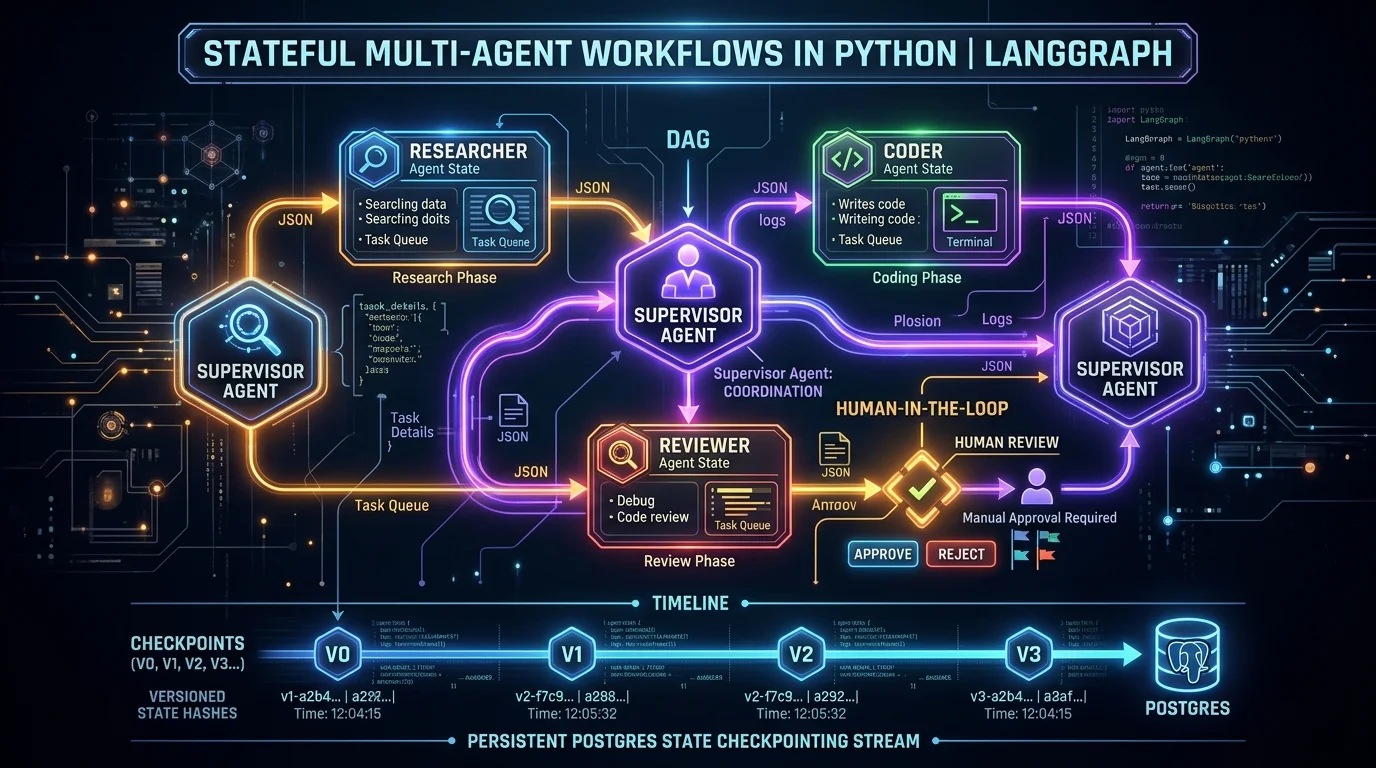
Most AI agent tutorials showcase toy scripts: a single LLM loop given three search tools running in an ephemeral Python memory buffer.
When engineering teams attempt to deploy these prototypes into enterprise environments, they invariably collapse:
- The Amnesia Failure: When a worker process crashes, times out, or reboots during a 10-minute multi-step research loop, the entire conversation state is obliterated.
- Context Window Saturation: Forcing a single generalist agent to retain the system prompts, schemas, and historical outputs of 25 different tools degrades attention accuracy and balloons token expenses.
- The Runaway Mutation Risk: Autonomous agents cannot be permitted to execute irreversible production side effects—such as triggering financial payments, mutating database rows, or sending emails to clients—without deterministic human approval gates.
To build durable, scalable, and audit-compliant agentic workflows in 2026, the industry has standardized on LangGraph: a cyclic graph framework designed specifically for stateful, multi-agent orchestration.
In this deep-dive architectural guide, we construct a production-ready multi-agent supervisor architecture featuring PostgreSQL state checkpointing (PostgresSaver), strict Pydantic state typing, and Human-in-the-Loop (HITL) interrupt gates.
1. Core Architectural Concepts: The LangGraph Triad
LangGraph models agentic applications as directed graphs where execution flows across nodes and edges:
┌────────────────────────────────────────────────────────┐
│                        STATE                           │
│   The shared memory schema passed between every node.  │
│   Updated via deterministic reducer functions.         │
└──────────────────────────┬─────────────────────────────┘
                           │
         ┌─────────────────┴─────────────────┐
         ▼                                   ▼
┌──────────────────┐               ┌──────────────────┐
│      NODES       │               │      EDGES       │
│ Python functions │               │ Control flow     │
│ that receive     │──────────────►│ logic:           │
│ state and return │               │ conditional      │
│ state updates.   │               │ routers & branches│
└──────────────────┘               └──────────────────┘
- State: A shared TypedDict or Pydantic class representing the single source of truth across all agents.
- Nodes: Discrete functions or specialist agents (e.g.,
researcher_agent,sql_agent,human_review_node) that compute updates to the state. - Edges: Conditional or direct routing logic that inspects the latest state to decide which node executes next.
2. Multi-Agent Topology: The Supervisor Pattern
Rather than allowing agents to communicate peer-to-peer in an unconstrained swarm (which creates infinite loops and non-deterministic behavior), we deploy the Supervisor-Worker Pattern:
                             [ User Objective / API Request ]
                                            │
                                            ▼
                           ┌─────────────────────────────────┐
                           │      Supervisor Agent Node      │
                           │  • Analyzes current task stage  │
                           │  • Emits next worker routing    │
                           └────────────────┬────────────────┘
                                            │
                 ┌──────────────────────────┼──────────────────────────┐
                 ▼                          ▼                          ▼
   ┌──────────────────────────┐ ┌──────────────────────────┐ ┌──────────────────────────┐
   │    Research Specialist   │ │   Data Analytics Agent   │ │ Human-in-the-Loop Gate   │
   │ • Web search & retrieval │ │ • PostgreSQL query exec  │ │ • Pauses execution       │
   │ • FastMCP document tools │ │ • Mathematical modeling  │ │ • Awaits admin approve   │
   └─────────────┬────────────┘ └─────────────┬────────────┘ └─────────────┬────────────┘
                 │                          │                          │
                 └──────────────────────────┼──────────────────────────┘
                                            │ Updates shared State
                                            ▼
                           ┌─────────────────────────────────┐
                           │   PostgreSQL Checkpointer       │
                           │   • Durable ACID persistence    │
                           │   • Full time-travel rewind     │
                           └─────────────────────────────────┘
3. Step 1: Defining the Typed State Schema
We define the state using Python's TypedDict combined with Annotated reducers. The add_messages reducer ensures new messages append to the conversation history rather than overwriting past turns:
from typing import Annotated, Sequence, TypedDict, Literal
from langchain_core.messages import BaseMessage
from langgraph.graph.message import add_messages
from pydantic import BaseModel, Field

class PlanStep(BaseModel):
    step_number: int
    task_description: str
    assigned_specialist: Literal["researcher", "data_analyst", "human_review", "finalizer"]
    is_completed: bool = False

class AgentWorkflowState(TypedDict):
    """
    Shared state across the entire LangGraph orchestration.
    """
    messages: Annotated[Sequence[BaseMessage], add_messages]
    objective: str
    plan: list[PlanStep]
    current_step: int
    requires_human_approval: bool
    human_approved: bool
    final_output: str
4. Step 2: Implementing the Supervisor Router
The supervisor evaluates the current progress against the plan and selects the next specialist using structured LLM output:
from langchain_openai import ChatOpenAI
from langchain_core.prompts import ChatPromptTemplate
from pydantic import BaseModel, Field
from typing import Literal

class RouterDecision(BaseModel):
    """Next specialist worker to activate based on state inspection."""
    next_node: Literal["researcher", "data_analyst", "human_approval_gate", "finalizer"]
    reasoning: str = Field(description="Explanation of why this node is selected next")

supervisor_llm = ChatOpenAI(model="gpt-4o", temperature=0.0)

def supervisor_node(state: AgentWorkflowState) -> dict:
    """
    Evaluates state and determines whether to dispatch to worker or initiate human review.
    """
    system_prompt = """
    You are the Senior Systems Architect orchestrating a multi-agent team.
    Your objective: {objective}

    Current Plan:
    {plan}

    Based on the latest messages, decide which specialist node should execute next.
    If a database mutation, financial calculation, or high-risk action is about to occur,
    you MUST route to 'human_approval_gate'.
    If the task is fully achieved, route to 'finalizer'.
    """

    prompt = ChatPromptTemplate.from_template(system_prompt)
    structured_llm = supervisor_llm.with_structured_output(RouterDecision)
    chain = prompt | structured_llm

    decision: RouterDecision = chain.invoke({
        "objective": state["objective"],
        "plan": state["plan"],
    })

    return {"next_worker": decision.next_node}
5. Step 3: Durable Memory Checkpointing with PostgreSQL
In-memory storage (MemorySaver) fails whenever a pod restarts. In production, we wire PostgresSaver, which records every single graph transition into PostgreSQL tables:
import psycopg
from langgraph.checkpoint.postgres import PostgresSaver

DB_URI = "postgresql://postgres:secure_password@postgres-cluster.internal:5432/agent_memory"

def get_production_checkpointer():
    """
    Initializes a connection pool to Postgres and returns a durable checkpointer.
    Automatically creates 'checkpoints' and 'checkpoint_writes' tables on first run.
    """
    connection = psycopg.connect(DB_URI, autocommit=True)
    checkpointer = PostgresSaver(connection)
    checkpointer.setup()
    return checkpointer
With PostgresSaver, each execution is identified by a unique thread_id:
- If an agent pauses to wait 4 days for an executive human email confirmation, the server process can shut down completely.
- When the human resumes the workflow, LangGraph reloads the exact thread state from PostgreSQL and continues execution seamlessly.
6. Step 4: Human-in-the-Loop (HITL) Interruption Gates
LangGraph provides native support for halting execution before entering high-risk nodes using the interrupt_before configuration:
from langgraph.graph import StateGraph, START, END
from langchain_core.messages import AIMessage

# Define worker functions
def researcher_node(state: AgentWorkflowState) -> dict:
    # Specialist web retrieval logic
    return {"messages": [AIMessage(content="Extracted technical metrics from external APIs.")]}

def high_risk_mutation_node(state: AgentWorkflowState) -> dict:
    # High stakes action (e.g., executing database update or dispatching wire)
    return {"messages": [AIMessage(content="Mutation executed successfully.")]}

def finalizer_node(state: AgentWorkflowState) -> dict:
    return {"final_output": "Objective accomplished."}

# Build the Graph
workflow = StateGraph(AgentWorkflowState)

workflow.add_node("supervisor", supervisor_node)
workflow.add_node("researcher", researcher_node)
workflow.add_node("high_risk_mutation", high_risk_mutation_node)
workflow.add_node("finalizer", finalizer_node)

# Add Edges
workflow.add_edge(START, "supervisor")
workflow.add_conditional_edges(
    "supervisor",
    lambda state: state.get("next_worker"),
    {
        "researcher": "researcher",
        "data_analyst": "researcher",
        "human_approval_gate": "high_risk_mutation",
        "finalizer": "finalizer"
    }
)
workflow.add_edge("researcher", "supervisor")
workflow.add_edge("high_risk_mutation", "supervisor")
workflow.add_edge("finalizer", END)

# COMPILE GRAPH WITH POSTGRES CHECKPOINTER AND HITL INTERRUPT
checkpointer = get_production_checkpointer()

app = workflow.compile(
    checkpointer=checkpointer,
    # HALT EXECUTION before high_risk_mutation runs!
    interrupt_before=["high_risk_mutation"]
)
7. Step 5: Handling Human Approvals in FastAPI
When execution halts at interrupt_before, the application returns the current state to the user interface. When the human clicks Approve or Reject, we resume the thread:
from fastapi import FastAPI, HTTPException
from pydantic import BaseModel

api = FastAPI()

class ResumeThreadRequest(BaseModel):
    thread_id: str
    action: Literal["approve", "reject", "modify"]
    human_notes: str = ""

@api.post("/agent/resume")
async def resume_agent_thread(req: ResumeThreadRequest):
    """
    Resumes a paused LangGraph thread following human review.
    """
    config = {"configurable": {"thread_id": req.thread_id}}

    # 1. Fetch current paused state from Postgres
    current_snapshot = app.get_state(config)
    if not current_snapshot.next:
        raise HTTPException(status_code=400, detail="Thread is not in a paused state.")

    if req.action == "approve":
        # Resume execution with None (proceeds through interrupted node)
        for event in app.stream(None, config, stream_mode="values"):
            pass
        return {"status": "RESUMED_AND_COMPLETED"}

    elif req.action == "reject":
        # Update state with rejection feedback and route back to supervisor
        app.update_state(
            config,
            {"messages": [AIMessage(content=f"Human rejected mutation: {req.human_notes}")]},
            as_node="supervisor"
        )
        return {"status": "REJECTED_AND_REROUTED"}
8. Production Guardrails: Recursion Limits & Observability
1. Circuit Breakers (Recursion Limits)
Agents can get stuck in analytical debate loops. LangGraph enforces a strict execution ceiling via recursion_limit:
config = {
    "configurable": {"thread_id": "session-prod-9921"},
    "recursion_limit": 25 # Halts execution after 25 transitions to prevent infinite loops
}
2. Distributed Tracing with LangSmith
Always export traces to monitor token usage and latency bottlenecks:
export LANGCHAIN_TRACING_V2="true"
export LANGCHAIN_API_KEY="your-langsmith-key"
export LANGCHAIN_PROJECT="enterprise-multi-agent-cluster"
Frequently Asked Questions (FAQ)
When should I use LangGraph instead of simple LangChain chains?
Use LangChain chains for linear, predictable workflows (e.g., Prompt $\rightarrow$ Model $\rightarrow$ Parser). Use LangGraph whenever your workflow contains loops, multi-agent collaboration, branching conditions, persistent state across user sessions, or human approval gates.
How does LangGraph handle database connection pooling in high concurrency?
In production, wrap psycopg_pool.AsyncConnectionPool with AsyncPostgresSaver. This prevents individual agent workers from exhausting PostgreSQL connection limits during traffic spikes.
Can I rewind an agent's memory to an earlier step (Time Travel)?
Yes. Because PostgresSaver records immutable state snapshots at every step, you can call app.get_state_history(config), pick any historical checkpoint_id, and fork execution from that exact historical moment with modified parameters.
Architecting complex agentic AI systems, enterprise workflow automation, or stateful Python pipelines? Explore my AI Automation Services or Reach Out for an Architecture Consultation.